Listen up. Because this story is about you and me. Once upon a time there was a little kid. The kid had a dream. Stop. Fast forward two to three decades into the future. Over the years the kid managed to survive, to obtain a few degrees and, luckily, even topped some of the exams on the way. Sounds familiar? Where did it all lead the kid? Where did it all lead you? It all led you to a job that sort of pays well. You are doing okay. Not great. Not like you won the Nobel prize. Not that your passion is shooting out rainbow rays bursting out of the pale walls of your office and hitting the guy making his eighth cup of coffee in a bureau across the street. Or maybe, shockingly, it all led you to a six-month period of hell we famously call the Job Hunt.
And you are sitting there, with the dishes still in the sink, watching a series on Netflix, unable to budge, with this heavy feeling that you need to turn things around—but how? Is it disappointing to wake up one day and admit that, well, it seems like you are not very talented after all? That so and so from work or school is better, a genius, and that you can never really hope to catch up even if you badly wanted to. That they are ‘talented’ in the real sense of the word. That things come naturally to them. That it is easy for them to do what they do.
Is it disappointing?
Or rather do you feel relaxed after thinking this way? What you just declared impossible does not require any more work. If Tom and Suzy from work are simply geniuses, you don’t need to get up from the couch and put in the work. Well, I have some bad news for you. I am going to make us feel uncomfortable right here, right now.
Read on.
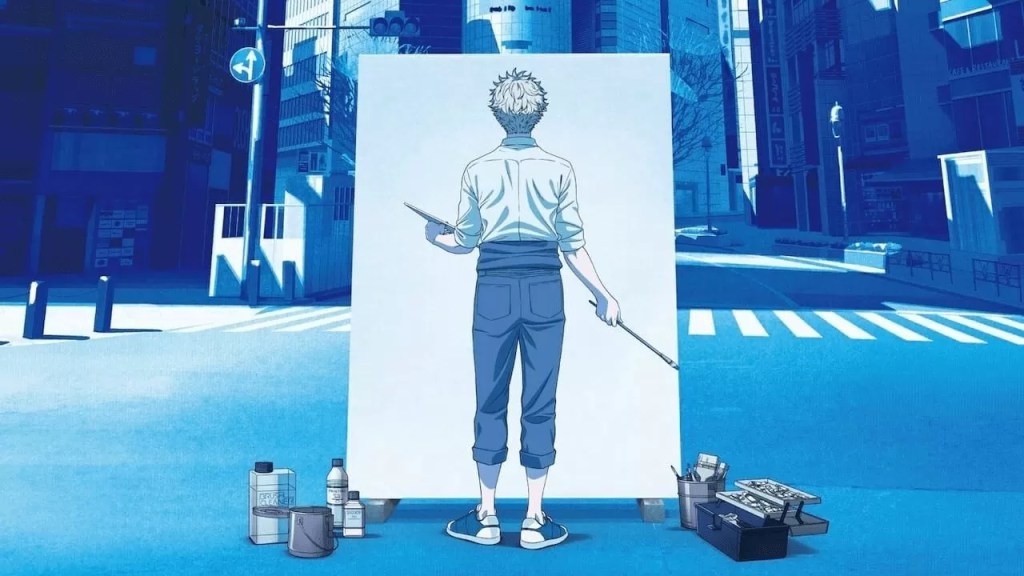
Let me tell you something about myself. Admitting that I am in trouble does not come easy to me. I carry the uneasy feeling around without sitting myself down and listening to what is going on inside me. For days at a stretch. Luckily, in my efforts to escape from this feeling, I began watching the anime Blue Period on Netflix, based on a manga by Tsubasa Yamaguchi who calls it “a manga about working hard.” And as fate would have it, the anime picked on the exact uneasiness and confusion that I had been trying to avoid facing but badly needed answers to. The anime tells the story of Yatora Yaguchi who is shown to be a popular student at school while also managing to excel at his studies. What made me instantly relate to his character was a very random moment and the relatability kept growing out of proportion, till I was looking at the anime in hopes of finding an answer for myself. Let me tell you why.
I have been what you would call a hard worker for as long as I can remember. I cannot name one thing that comes easy/ naturally to me. So obviously I told myself at a very young age that for me to simply survive and be average was going to require humungous efforts. I come from an Asian household where grades can pronounce a life sentence and declare or predict, early on, your chances of survival in the world. So I was terrified. When I was young, I actually believed that my parents would abandon me if I failed to bring results. I could feel their disappointment as we sat down to eat if I had not been doing well at school. So I did what I had to do. I worked hard. Real hard. Sickeningly hard. I studied before, during, and after classes. I studied in advance. I studied while commuting. I gave myself more homework than what was given by the tutors. And soon, I became a top-tier student at my school. I carried this work ethic into my college days and I had juniors who would come up to me and say they envied how talented I was. And yet, I am not smarter or more talented than anyone else.
When I entered the university and lived away from my hometown, I was exposed to a different challenge—socializing. And god was I bad! I just could not read people and what they wanted from me. After many setbacks in my attempts to understand people and their variability and unpredictability, I finally managed to grow a smaller but closer circle. But even so, I was always afraid to tell them about the things I loved. So when Yaguchi in Blue Period decides to leave his partying friends early because he has a class in the morning or when he begins to doubt if the life he had built around him, watching matches and drinking, was actually his or someone else’s version of what his life was supposed to be, I heard him loud and clear. Was he getting carried away? Was he even having honest conversations with the people around him? Did they know that Shibuya appeared like a blue dream to him in the early hours of the morning? Could he tell them that? I had felt the same way. And like Yaguchi, I too began to open up with the people who I wanted to be close to and honest with. I began to show them my real self. And honestly, they did not mind it. Rather, it brought me closer to them and made me enjoy being around them even more as I continued to do so while being myself. In the anime, Yaguchi struggles to tell his friends about the blue Shibuya of early mornings, but his art is able to make that conversation easier. This thrills him.
In the anime, the debate of talent versus hard work is ever-present. For Yaguchi, art is an unknown realm. So he ends up mystifying its creative processes and the work that goes into it as pure talent. This is exactly what he ends up telling his senior Mori senpai—that she is amazingly talented and that he envies her. The painting by Mori is very inspiring for Yaguchi but comes across as an unapproachable pinnacle of something he is drawn towards but that he ends up shrouding in a mysterious air of innate genius, thereby relieving himself of the pressure to possibly pursue it. But when Mori responds to the contrary, Yaguchi realizes that it is exactly like the case where his friends dismissed his hard work as a free bonus that comes with being a genius. So when Mori says, “I am not talented. I just spend more time thinking about art than others”—he understands. She goes on to tell him: “Also, its necessary to study methods in order to make art. So just brushing it off as ‘talent’ is like I haven’t put any effort into it.” This is true. But it also means that Yaguchi cannot brush off his own lack of effort to begin as “So and so is more talented than me. They were just born that way.”
We, too, have to face it. A thought. A thought which we might have been denying for a long time now:
YOU NEED TO WORK HARD TO BE TALENTED AT SOMETHING.
It also means that:
There is absolutely nothing in the entire world that is impossible for you to learn or become good at.
It just requires persistence, passion, consistency.
It requires you to choose:
I WANT THIS. I AM GOING TO GET THIS.
But nah—these are mere words. The process is much deeper than that.
Whatever you want to do, you need to do more of it. But not just that. You need to study it deliberately. What they call ‘conscious learning.’ The correction of habitual mistakes. The learning of new things. Which is mostly too difficult to do and, more often than not, no fun at all. And this is the point where some people stay with the uneasiness and consistently carry on doing what they WANT to LEARN to do, and others quit and compromise, become mediocre, or fail.
Don’t just take my word for it.
Pick any success story and trace it back to its origins.
The answer is the same. As Ralph Waldo Emerson put it:
“Every artist was first an amateur.”
Or hear out Stephen King:
“Talent is cheaper than table salt. What separates the talented individual from the successful one is a lot of hard work.”
Or Kevin Durant:
“Hard work beats talent when talent fails to work hard.”
Let me give you more examples from James Clear’s article on “The Daily Routines of 12 Famous Writers.” Octavia Butler was not always a writer. She started off as a telemarketer, a dishwasher, a potato chip inspector, and did her fair share of odd jobs. Stephen King worked as a janitor, gas pump attendant, industrial laundry worker, wrote Carrie (rejected by thirty publishers) while living in a trailer with two small children to take care of. E.B. White made his living room, “a passageway to the cellar, to the kitchen, to the closet where the phone lives,” work as his writing space. Henry Miller warned: “Work according to Program and not according to mood. Stop at the appointed time!” Or “Write first and always. Painting, music, friends, cinema, all these come afterwards.” Or as Khaled Hosseini said: “You have to write whether you feel like it or not.” Barbara Kingsolver juggled being a mother with being a writer by showing up at her writing desk at four in the morning. Nathan Englander turns off his phone while writing. Like Ernest Hemingway or Kurt Vonnegut (both of them early risers), Haruki Murakami shows up, without fail, at his writing desk 4 am in the morning and continues to work for 5-6 hours. In his words:
I keep to this routine every day without variation. The repetition itself becomes the important thing; it’s a form of mesmerism. I mesmerize myself to reach a deeper state of mind. But to hold to such repetition for so long — six months to a year — requires a good amount of mental and physical strength. In that sense, writing a long novel is like survival training. Physical strength is as necessary as artistic sensitivity.
Haruki Murakami
You get the picture.
And why just stop there?
Take a moment and think about any one thing you did really well. Think about why you came to do it well in the first place? Were you encouraged at a young age and devoted yourself to it? Did you consciously learn it through trial and error, and what people saw was the end product of a cumbersome process? Either way, know this:
You can make the same thing happen and apply the same process to other things.
Bigger things.
Erica Jong said:
“Everyone has talent. What’s rare is the courage to follow it to the DARK PLACES where it leads.”
That dark place is a painful place of conscious learning. Often, it is not a fun place to be in. But if you want your dreams bad enough, you will stay in it and grow out of it.
So let’s get working.
Let’s show up at our desks and create magic.
Let’s get to a point when the dots are beginning to connect and rainbow rays do burst out of your pale office walls, hitting the guy making his eighth cup of coffee in a bureau across the street. Let’s imagine him waving at you as you pack up, ready to leave your 9 to 5 job to finally work at what you are insanely good at. (Just as Mori packs up her stuff, ready to attend the art university she had successfully got selected at after all that hard work.)
And when people say how talented you are, you go ahead and tell them exactly what went into it.
Consistent work.
As simple as that. As light and clear.
And just as difficult to do.
But a kind of difficult that you are willing to bear. A price you are willing to pay.
And like Yaguchi who says, “I should be proud of these pieces and the improvements I’ve made,” don’t forget to pat yourself on the back for all the little victories on the way.
Knowing that hard work is the only key there is can be daunting, but it is also a superpower in itself. This knowledge brings a responsibility with it. A responsibility to yourself and your dreams.
There is no choice to run away now.
We must face the music.
And while we are at it, let’s do it gladly.


 Uhi K;
Leave a reply to ruhietc Cancel reply