Solitude is a room we enter to escape all others. Loneliness is the one we wake up in, alone, when everyone leaves.
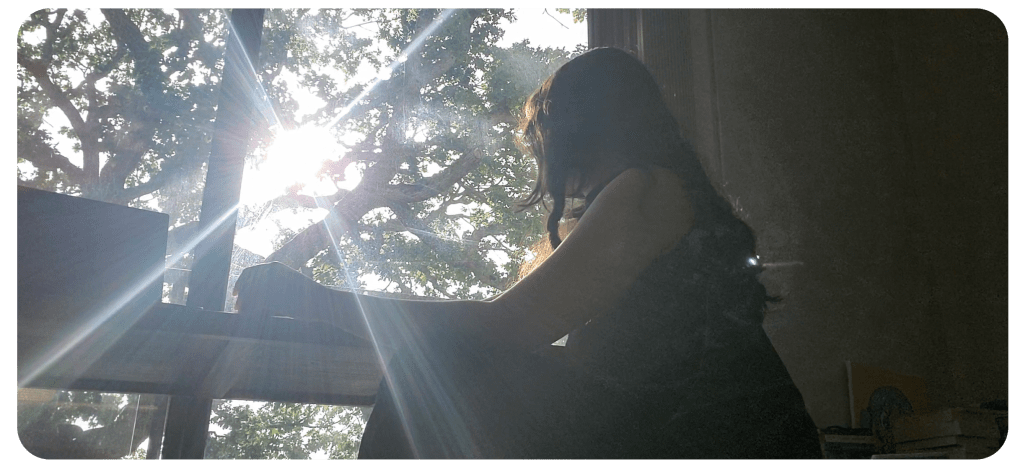
Through closed eyes, I feel the tiny hands of the sun playing with the wind in the trees, and say to myself, “Wasn’t this enough the other day, when I swore I saw God?” Why is it then— (And this I don’t say out loud) Why is this moment failing me so? There was a time I thought this was enough. So I counted the sun, the leaves, and the birds, and placed them all in my pocket. Now in this moment, which comes for us all, one at a time, and is here for me now, I empty all my pockets and I see a sky bricked up and painted blue, paper birds glued to the ceiling and I think of time as it is for my mother— one long tunnel moving both forwards and backwards. Suddenly, I am again sleepwalking as on a heated afternoon sitting at the back of a rickshaw in a bazar, and wake up suddenly in all the din of the real and here. Or when I was ten and during a power cut I looked into the heart of a candle flame and had an epiphany that time would continue to pass without me if needed and woke up again with that thought on another day, 20 years later, like a twig that fell down the river once, still finds itself drifting every day, unable to stop. I think now of a life that seems like a lifetime away already. I think of my father watching TV in the other room, and my brother studying, and now following my mother to the kitchen, and my mother following him back and then stopping by my father, commenting on some ordinary thing or another. Perhaps the weather. Perhaps the grocery list. Perhaps a bill that needed to be paid. It feels like there was more of us to go around then. More annoyances too. More spaces to be cut into other spaces. More reasons to open and close our doors, and turn away our eyes and ears. The wind chime is the only sound here now and outside only the downtown sirens sing. Downstairs, a man plays the drums. Next door, a jingle of keys and some fumbling and a clearing of throat. Sometimes, I imagine these strange people across these walls, sharing the same air and water, and think of them as my many uncles, aunts, cousins. I guess, in a way, we are one big family here, in this apartment building.
Category: Journal
-
2 comments on The Apartment
-
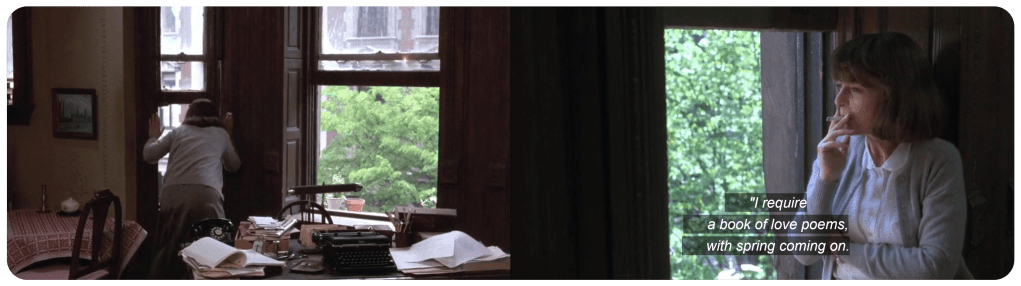
Spring drew on… and a greenness grew over those brown beds, which freshening daily, suggested the thought that Hope traversed them at night, and left each morning brighter traces of her steps.
Charlotte Brontë
But the true nature of the human heart is as whimsical as spring weather. All signals may aim toward a fall of rain when suddenly the skies will clear.
Maya Angelou
Go grab your favorite cup of coffee (or tea, if you prefer tea) in your favorite mug, find a sunny spot around, and curl up. If you have a cat or even better, cats, do let them know they are welcome. We are going to talk all things spring, poetry, and the art of being present (with a healthy scoop of existentialism, of course).
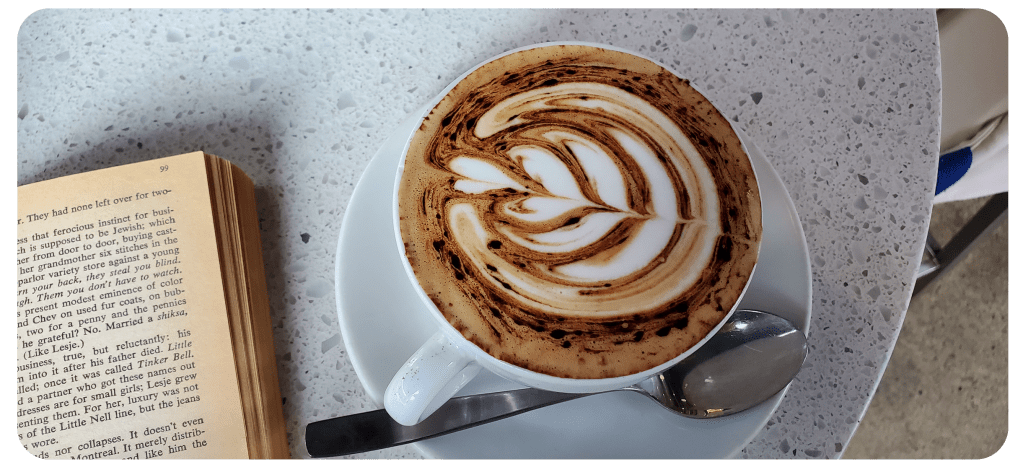
The world continues to warp around us, but spring is here as always, the buds poking their heads up as they have done for centuries, the blades of grass continue to flutter in the breeze, following their own meditative rhythm. And so should we.
You were not just born to center your entire existence on work and labor. You were born to heal, to grow, to be of service to yourself and community, to practice, to experiment, to create, to have space, to dream, and to connect.
― Tricia Hersey, Rest Is Resistance: A ManifestoYou know, when I was little, I imagined if I could choose a name or a month I would have loved to be born in, I would say April. Though, being a May child is close enough.
But May is the child of summer. And spring has my heart.
And even though it is not so warm yet, I cannot wait to ditch my so many sweaters and jackets and scarves and appear out of it all, in my white tee and shorts, barefoot like Heidi, and run down the green slopes of the Alps, feeling light as a feather.
And ’tis my faith that every flower
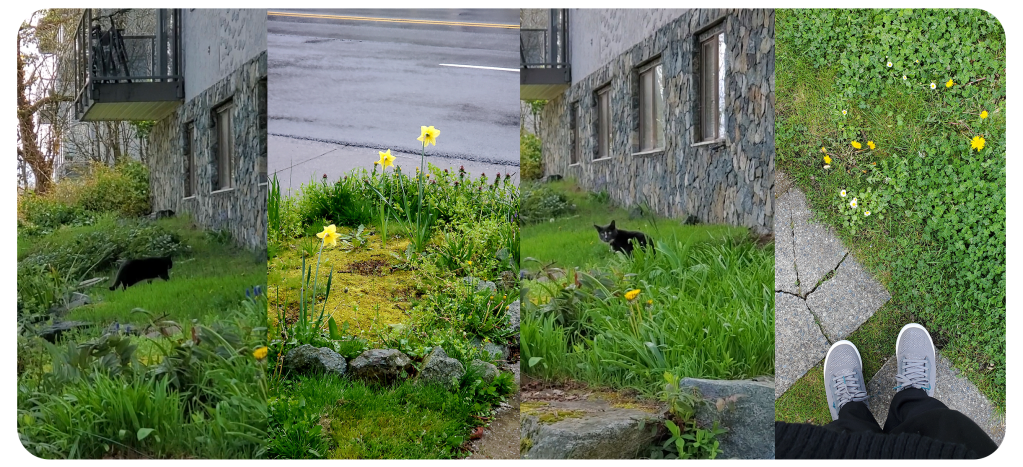
Enjoys the air it breathes. – William WordsworthI can see daisies, daffodils, and dandelions, sprouting all around the place. I am beginning to run into more and more neighborhood cats coming out of their secret gardens. The cherry and plum blossom trees have started sprinkling the boulevards with their pink and white spring showers. Come to think of it, without trees to remind us, there are no seasons.
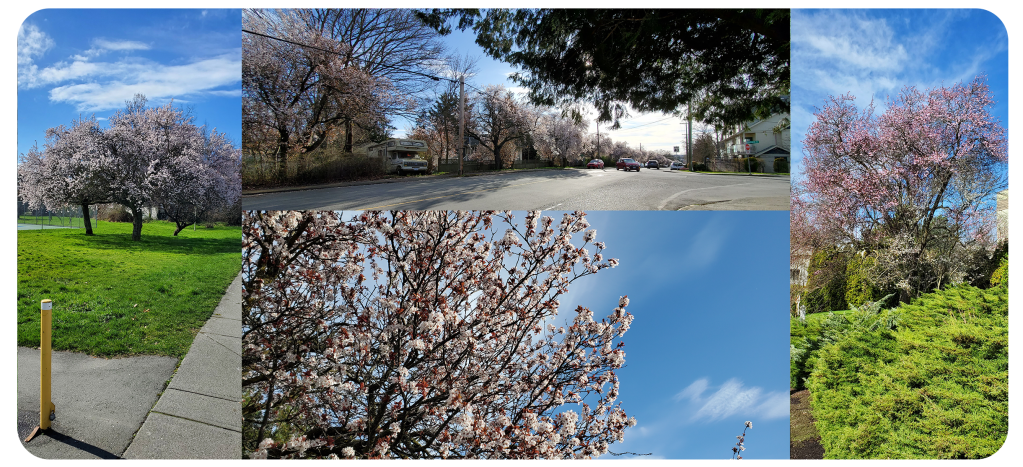
The more I observe the spring trees with their buds and blossoms, the sky that continues to grow brighter and ever so bluer, and the birds that are getting livelier and fluffier, twittering heartily, the more I see all that is wonderful in them, and all there is to learn from them. The tree facing my window feels like an old friend, changing with me. I invite the birds to my balcony, enticing them with sunflower seeds. When I work out, as much as I would be delighted to be mistaken for the swaying branch of a tree by the birds, I lack the grace and loving wisdom of my wonderful old friend. I like the certainty of its steady presence. I learn from its ever-changing frame and flexibility while being rooted in one place.
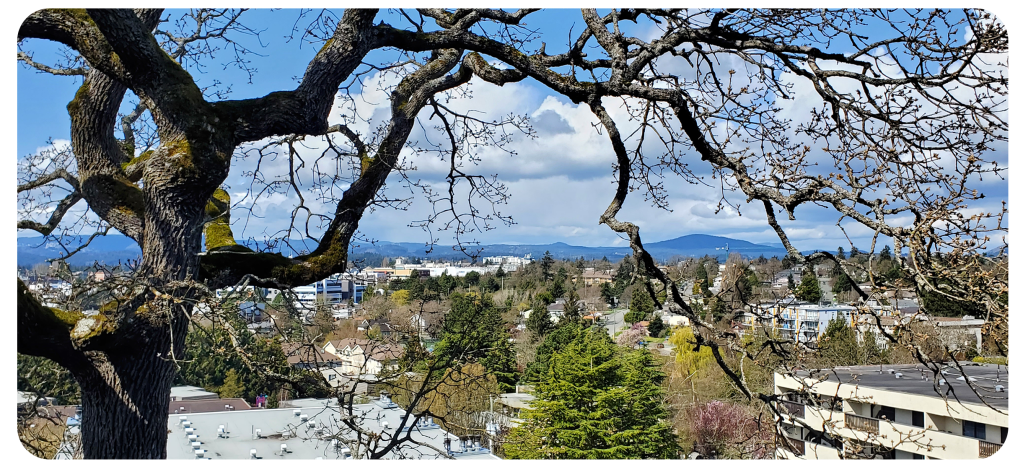
When I moved here, it was completely bare. The birds still held on, clipping at some buds that seemed so tiny that I felt they weren’t even there. I thought the tree was dying. There it was, brown and bare, standing in the middle of this floral cornucopia and a flurry of green flittering fullness of all the other trees in the area. And just when I grew fond of its bareness, urging it to hang in there, it sprung to life. Almost overnight. Like a miracle. Na. Scratch that. A miracle. For it was a miracle.
This Morning by Mary Oliver
This morning the redbirds’ eggs
have hatched and already the chicks
are chirping for food. They don’t
know where it’s coming from, they
just keep shouting, “More! More!”
As to anything else, they haven’t
had a single thought. Their eyes
haven’t yet opened, they know nothing
about the sky that’s waiting. Or
the thousands, the millions of trees.
They don’t even know they have wings.And just like that, like a simple
neighborhood event, a miracle is
taking place.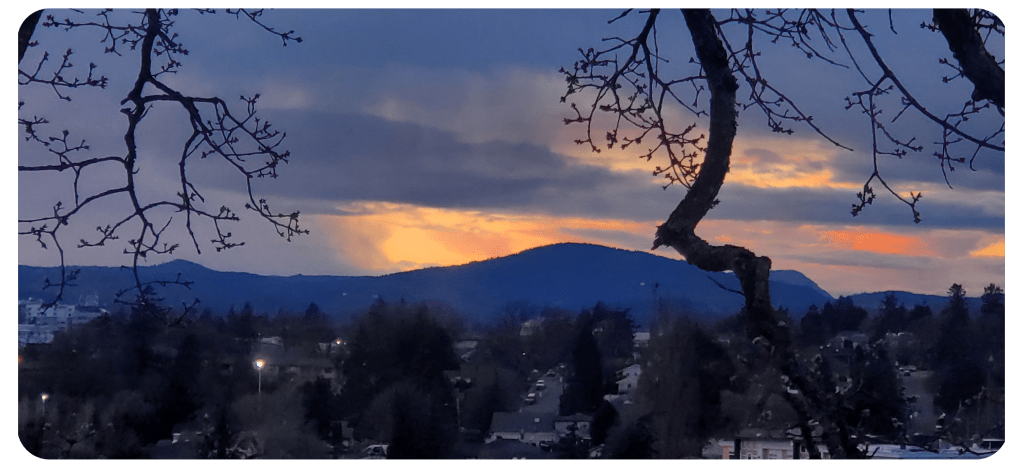
I Wake Close to Morning by Mary Oliver
Why do people keep asking to see
God’s identity papers
when the darkness opening into morning
is more than enough?
Certainly any god might turn away in disgust.
Think of Sheba approaching
the kingdom of Solomon.
Do you think she had to ask,
“Is this the place?”How easy it is to take nature and what is natural for granted. Oh, the miracle of this body, the world that is alive! The poem the sun never ceases to write on the sky, with every rise and fall. The wind that roams the world, kissing everything. Gravity that never ceases to tell me that it wants me, a call I never fail to answer as I snuggle back into bed or the couch for a few more minutes of napping. I am grateful. There is much pain in the world, there are days when I feel like a blank and everything feels dreary and pointless and yet I am grateful for what is. Throughout the day, I follow the sun. I stay by the window. The sky helps me breathe. I check on it again and again just to make sure it’s still there.
I too have known loneliness.
I too have known what it is to feel
misunderstood,
rejected, and suddenly
not at all beautiful.
Oh, mother earth,
your comfort is great, your arms never withhold.
It has saved my life to know this.
Your rivers flowing, your roses opening in the morning.
Oh, motions of tenderness!– Mary Oliver, “Loneliness”
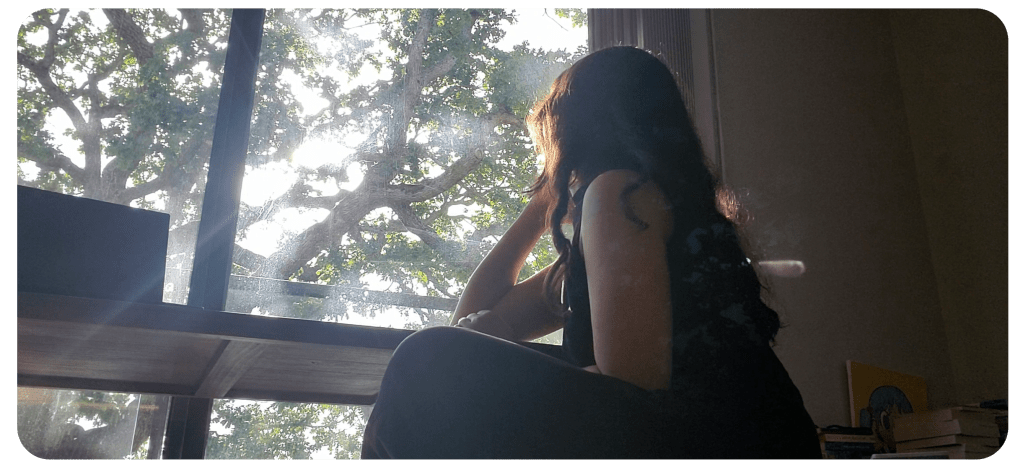
I really feel connected to the tree. I am beginning to understand and root myself in its stillness, and move, and find a whole another life in it. There is no need to go anywhere. Everywhere can be found anywhere, if you look close enough and have enough love in your heart for it. Though, with the water in us, we are bound to grow restless too, and in that, we ebb and flow like the waves. The land, water, and air bind us all together and set us free.
On some afternoons, I can feel the tree, all of its being looking and feeling, alive, gracious, and open, with a loving gentle gaze that doesn’t understand fear or separation, so at one with the sky above, the ground below, and open to what life chooses to surround it between the two. In my friend, I sense no divide between the perspicacious mind and the warm beating heart. The immensity of it, the humility of it. All I seek in a God, right here.
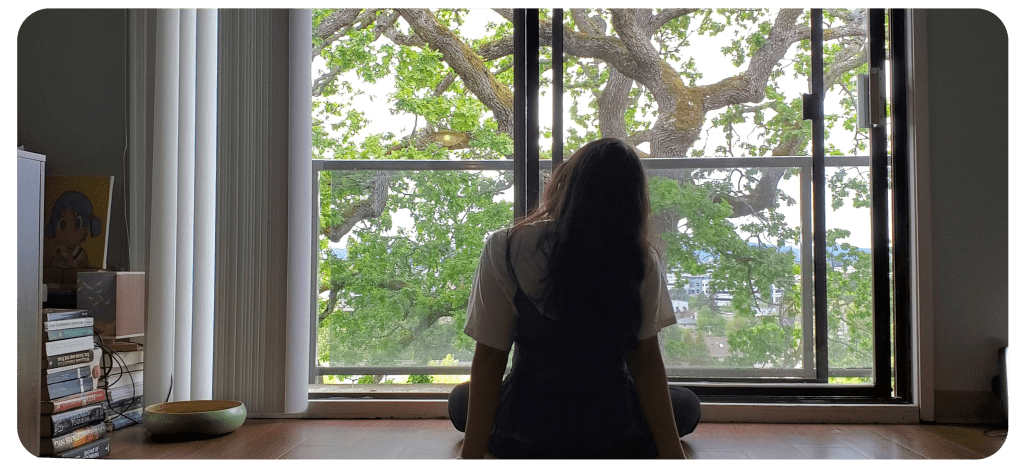
I admit I feel a bit deformed in the face of this company. A part of me is spiritually stunted shaped by the noise none of us can escape. A thigmotropism of sorts. Though whatever we have kept away, open only to the sky, continues to grow more and more, deeper and fuller and further inwards and outwards. A corm of sorts, a silent room for the mind. Though I love the moments of stillness when the door to that room opens and the conversations that sometimes flow from there.
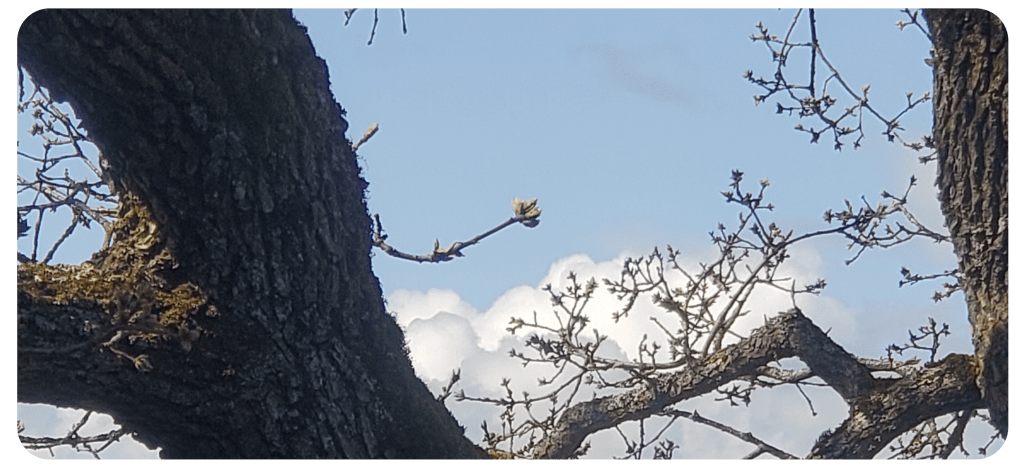
Have you felt the stream of eternal time that we can only touch for a moment yet never imbibe? Here’s an exercise. Find a tree, a plant, a flower, anything in the wilderness or in the balcony outside your window. Or the sky. And for some time, sit still and give it all of your attention. Observe. Do not seek to dissect. Just stay in the moment with it, at its pace. Imagine you are the sky. The tree. The plant. Think of the hours that seem to go on endlessly. Experience how time expands and slows down. Take a deep breath. And then notice, in contrast, the world around, running at such a high speed, burning through time. We think if we pack a lot in a short amount of time, we can expand how we experience time. But seems like we have it backwards. All my life, the moments that I can replay in slow motion, that seem to grow even more immense as time goes on, were moments of inner stillness and slowing down, what is called ठहराव (Thehrav: the stillness that comes with patience, calmness, and the quality of being relaxed, with a still quiet confidence and contentment) in Hindi, moments when the door to that secret room of the mind opens up and the space where change first blossoms.
In India, spring is the season of temperate pleasant weather and arrives much sooner in the year. The wintery chilliness of the shade thaws and the cold wind, warmed up by the sun, turns into a cool pleasant breeze. I still remember how I knew as a child when spring came around. I still wore my socks, but the sweaters turned into vests. The potted plants on the terrace began to sprout buds- orange, yellow, and pink. My father moved his chair slightly towards the dappled shade. My mother took out her yellow saree and the season of Basant came around, filling up the skies with kites of all colors, shapes, and sizes. Children on terraces everywhere, in a joyful hypnotic state turned up like bright flowers looking at the warm blue sky full of milky white clouds yet untouched by the scorch of summer. Their mothers, gathering the crisp clean laundry smelling like the sun, constantly worried about them falling off the short balustrades, and shouted at them over and over again to be careful and were ignored. Shouts of Ai-Bo could be heard in each direction as kids engaged in competitions to cut down their opponent’s kite. One child’s kite set adrift in the free wind became another’s treasure, floating down from the sky. How many times did my brother get distracted by those shouts while doing his homework in that season? Sometimes a stray kite would land right by the bedroom window and how could he resist? He could even hear it coming down, if it ever got stuck in the branches of the Rangoon Creeper at the back of the house. He just couldn’t wait to get his kite up in the sky and how excited were we to write something on it so that if it were to fall into another’s hands, it would be like exchanging a secret message. The tiny words flew up into the sky, open to all, yet readable by none from that height, their fate resting on the winds.
I have read poems describing the beauty and abundance in autumn and even winter. And I know spring is the season where growth that has been invisible like an underground stream, sprouts through and is made apparent. It is the timid walk of newly sprung beauty on its way to become more and more flamboyant. I confess I love spring’s promise of summer more than summer itself. But what fascinates me even more is the back and forth between the realms of winter and summer that is inherent in this season. You can often see the sky split into layers of grey and blue and intermittent rain and sunshine. This is the season that prepares the mind to face everything with the same humility and composure, both joy and sorrow. A season that welcomes both weathers with open arms and holds in it the blossoming hope for a better tomorrow is truly a lovely one.
I also believe that the same is true of human spirit too. We need intermittent sun and rain. Spring showers are necessary for the growth that takes place in this season. Just as sunlight is. We too need change and challenges to grow as well as moments of love and appreciation.

As I look outside right now, I can see the tree yet again as I first saw it a year ago. This time, I can see the buds and I know how they will fill up the branches in a lush green gladness and filter out the scorching light from the summer sun into a beautiful kaleidoscope of komorebi that will play across my floors. But what I can also foresee is the autumn day when slowly, one by one these very leaves will float away like ghosts of the past and how I will try to catch them in my balcony, stowing some away in books, with a sinking feeling of something passing away and my own inability to capture and stay locked with them in an eternal spring. But I see the budding branches and they seem to dance and chime in, “We are here now. We are here now.” They seem to be saying, life is now. Always now. We are not a prequel. It is happening right now. And I answer back, “I am here. I am now.” And that is enough.
Sometimes when I am in a moment I find too beautiful for words, I find myself feeling tormented by its transience and my own inability to stop time and capture it. There are things I want to say to my dad that I felt no need to say back then but now I do. I want to ask him how with all he had experienced in life with all its sorrows, did he manage to keep all that was dark away from us and share only joy and love? Sometimes I want to tell him how having him in the world made me feel invincible. But when I was invincible, I felt no need to tell him, the way I do now. The world has cracked up and I need so much love to fill it back up and it will still not be enough. I feel so afraid to ask for it.
These days, I do feel a little lost and dejected but also full of hope and anticipation, as whimsical as the rain and shine of April. I feel like the world around me and my life can no longer be taken for granted and left on autopilot. It is no longer a question of expectations and walking on paved roads. The linear gameplay has been replaced by an open world. I feel like I am walking through a wild forest and as much as I am gleefully startled by its surprises and enchanted by its strangeness, in awe of the many little paths that can be carved through it, I also miss the guidance and companionship of the road well-travelled, saturated by road signs and set ways and times of doing things, the mainroads of existence that are tried and tested.
Especially in my 30s, I am beginning to discover that the more I try to find my own path, the lonelier it gets.
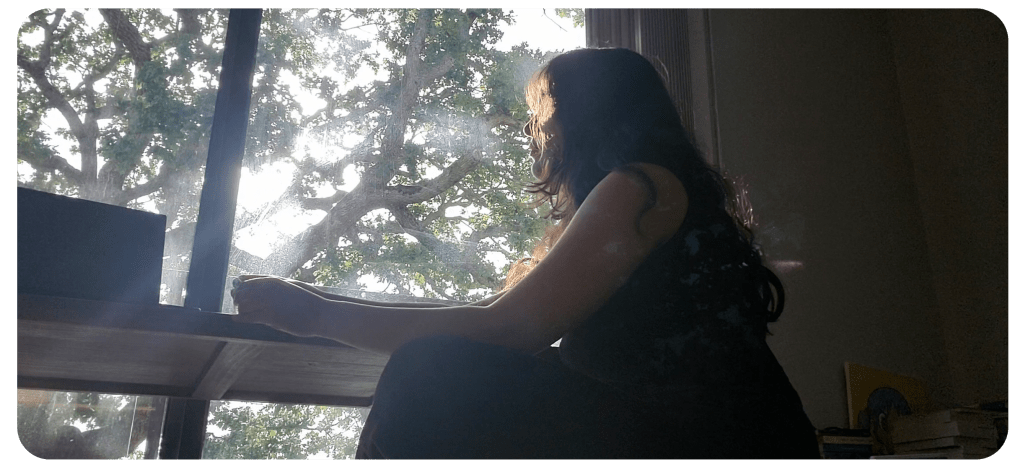
In that sweet mood when pleasant thoughts
Bring sad thoughts to the mind. – William WordsworthI am beginning to understand our reliance on systems and traditions, generation after generation. Why we need all the ways to distract our minds for they are prone to look at the abyss of the infinite universe. Ask a suffering man and he will tell you why the finitude of our bodies and the forgetfulness of our minds as we slowly grow senile is a blessing too. Why it is important to go through the decline that comes with age, to detach from the life we do come to love, especially since it is finite. How many times do we find some moments momentous especially because we know they will not last except maybe as a wonder memory and a finite one at that.
I always imagined freedom as a blue sky with its immense possibilities. But the endless skies eventually open up into an immense blank space where, whether one is prepared or not, terrible beauties await. And life till now has not given us a wide palate for relishing those cosmic scenes with calmness. For faced with a completely empty dark space, face to face with a cosmic event, who would not miss a sunny windowsill blessed by a house cat, unread books, and unwashed coffee cups, opening into a busy street teeming with people and their dogs and their vehicles, where meaning is still being made, unmade, like a bed full of dreams indistinguishable from reality?
Faced with freedom, it is natural to feel lost. In those moments, I try not to look away from the tree outside shaken by the wind under a stormy sky. For spreading your branches to the sky does not mean opening yourself up only to its blue immensities. Freedom may not offer the same shelter that cages do. But you can take a deep breath and brace yourself and pray for an openness to face anything that may come, rain or shine. Spring is a living proof of this.
The weather changes so drastically in a couple of minutes these days, it is startling. The tree holds my gaze as the sun grows dim behind the clouds, swaying in the breeze, and it continues to do so as the sun beams brightly on my face once again. It is almost saying, soothingly, “It’s okay. Everything is okay. It is all the same.”
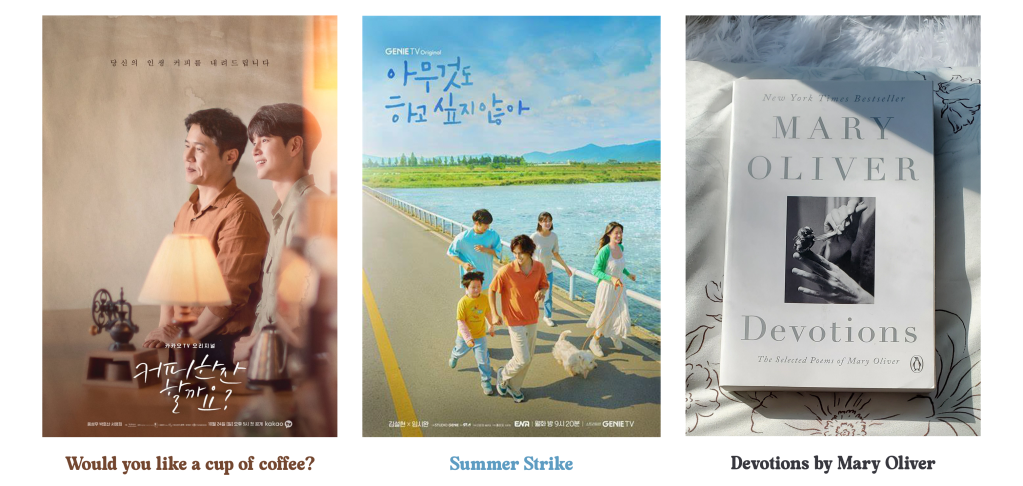
Lately, I have been watching Korean series again and I am glad I am. Their slow pacing and attention to the little details of ordinary life remain unmatched. These days, I am watching a series called “Would you like a cup of coffee?” and every time someone drinks coffee in it, which is a lot many times, I find myself making a cup too.
I am also napping a lot lately. Something to do with the change of weather and being in my 30s I guess. I am discovering that for taking naps in the spring sun, there is nothing better than reading poetry and dozing off till you are half awake in the poem and half dreaming it into being.
(For this spring season, here are some of my recommendations 🙂
I attended a marketing presentation last year which talked about how humans tend to make most of their decisions based on emotions rather than rationality, that is, heart over mind, contrary to what we might want to believe. And it is so easy to spend a lifetime fooling ourselves into thinking otherwise. And if that is so, we come to realize, how important it is to take care of how you make yourself feel, how you make those around you feel. It is easy to shove your feelings under the carpet because you don’t have time for them. But believe me, if left unattended, they can run the show, even from the sidelines.
(By the way, did I mention, horror and psychological thriller happen to be their favorite genres?)
The world is an overwhelming place to be in right now. I get it. But look at how spring arrives nonetheless and spreads itself over everything. Our joys and sorrows alike. And that too is a lesson. I am beginning to realize that when faced with irresolvable problems, when you are in the weeds of existence, it might be easier to focus on planting your garden. Instead of being hyper-fixated on what it is that you cannot resolve, focus your energy on things that you want to do, things that make you happy, small healthy habits that seem possible to accomplish, and things that are in your control.
Like spring cleaning. Like making art. Like dancing.
And slowly, you will find the wildflowers overtaking the weeds.
So, what are you planning to plant in your garden this season?
Just remember, all the raw materials that make you your most authentic self are already there with you and always have been.
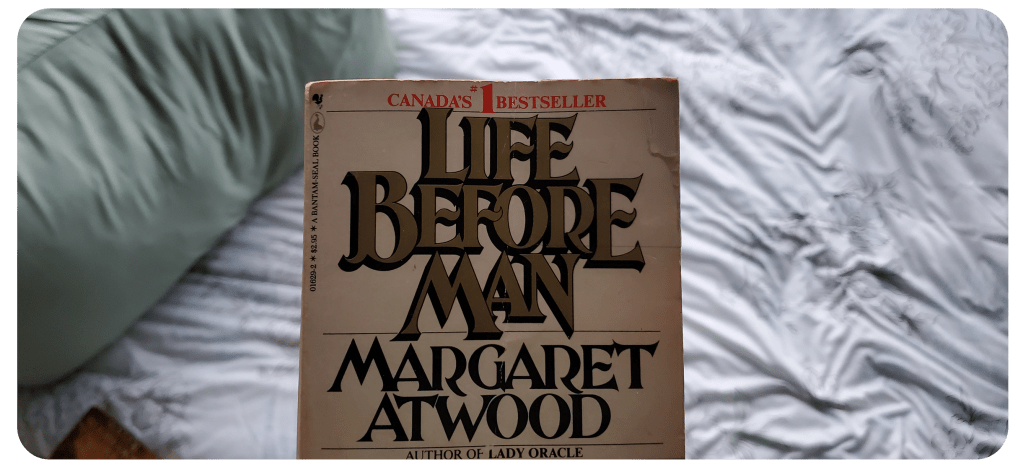
I read Margaret Atwood’s Life Before Man recently, and came across these lines:
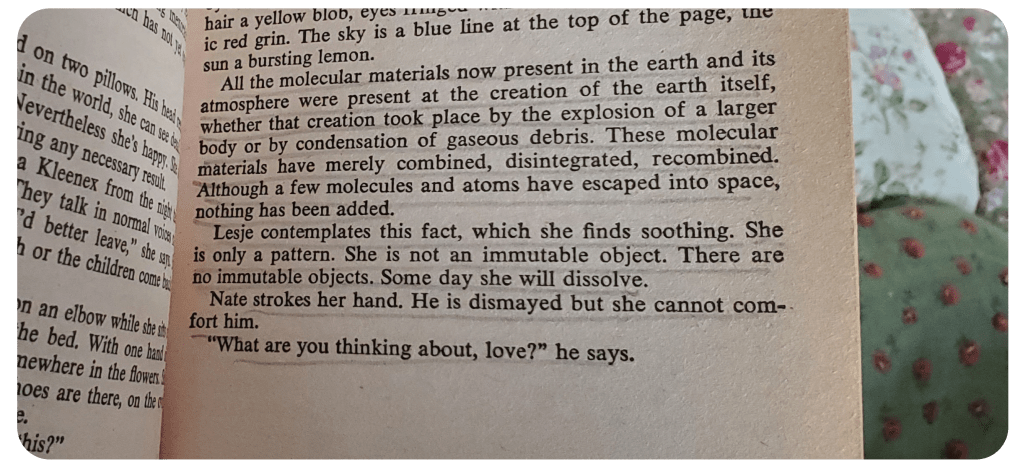
And I wonder how they make you feel.
(Also, do you share my love of old brown books?)
Let me sign off with another poem by Mary Oliver, and I will leave you with a sweet aftertaste of her words.
(Until next time, take care and don’t forget to stop and smell the roses! 🙂
On Meditating, Sort Of by Mary Oliver
Meditation, so I’ve heard, is best accomplished
if you entertain a certain strict posture.
Frankly, I prefer just to lounge under a tree.
So why should I think I could ever be successful?
Some days I fall asleep, or land in that
even better place — half-asleep — where the world,
spring, summer, autumn, winter —
flies through my mind in its
hardy ascent and its uncompromising descent.
So I just lie like that, while distance and time
reveal their true attitudes: they never
heard of me, and never will, or ever need to.
Of course I wake up finally
thinking, how wonderful to be who I am,
made out of earth and water,
my own thoughts, my own fingerprints —
all that glorious, temporary stuff.
-

Okay, so we have a mouse problem. Or a mice problem.
One thing is for certain, I have not seen more than one at a time. But I am not sure if it’s the same mouse I see (or, more often, hear) every time, or a different one. I have not noticed anything remarkable like a bitten ear or something for me to distinguish if it’s the big bad boy Johnny from the dumps who got that cut in a deadly alley pipe fight, or his little timid brother Joey with a pink feet fetish.
I had been noticing the signs for a few days. Food stuff or some random shavings found at the odd place, bite marks on my tatami. I brushed them off as, oh maybe it was Chanchal, my partner, having a midnight snack or something. (Not the bite marks on the tatami. That would be concerning, for both of us.)
And so, it continued for some days till one day, as the day always arrives when the phantom sound finally gets a face attached to it, or feet, whichever is your preference… One day, I was sitting on the couch, reading a book, and I look to my side and there it is… this tiny little thing, with two little ears and an eager nose, right there, on the mat, looking around with shiny eyes, taking its sweet time. I really wanted to reach out and say, “Hey sir, would you like a shopping bag with that?”, “Can I interest you in our special menu for the day? The usual snack stash? How about we try some cardboard or fabric for a change?”
When I lived in Chandigarh in India, I had a room on the roof. I traded amenities for independent living, I guess, when I picked that place to stay during my research. Don’t get me wrong, it had its own charms. The clouds came down on my roof top at night, I never had my fill of seeing the stars so close. The rain brought its own charms as I looked out through my little window at the hustle bustle of the street.
But my god, did I fight some wild battles there.
I remember the first time a cat walked into my room. That was heavenly. But soon other things followed. Not so heavenly.
It started with ground attack. Cockroaches. Oh man, it was not good. Nope. They had this strange way of creeping up suddenly. Sometimes, I would be working on my thesis for hours in the middle of the night till I began to see spots in front of my eyes and in my peripheral vision, there it would be, a lone cockroach, scuttling along the floor. At first, I always thought it was a figment of my imagination. But turns out, it was a real cockroach almost always.
Now trust me, I kept that floor cleaner than a church alter every single day. Like crazy. (Something to do with the avoidance strategy I had developed to cope with my denial around procrastination.)
So, I have no idea why they came. Or for what.
But the cockroach was very much there, scurrying around, ceaselessly, and then suddenly pausing like Inspector Clouseau, its moustache twitching, looking vacantly into space.
As if that was all. But no. This was a ground attack that could at any moment turn into an aerial attack. Ever heard of the flying cockroach? The most terrible thing made by nature.
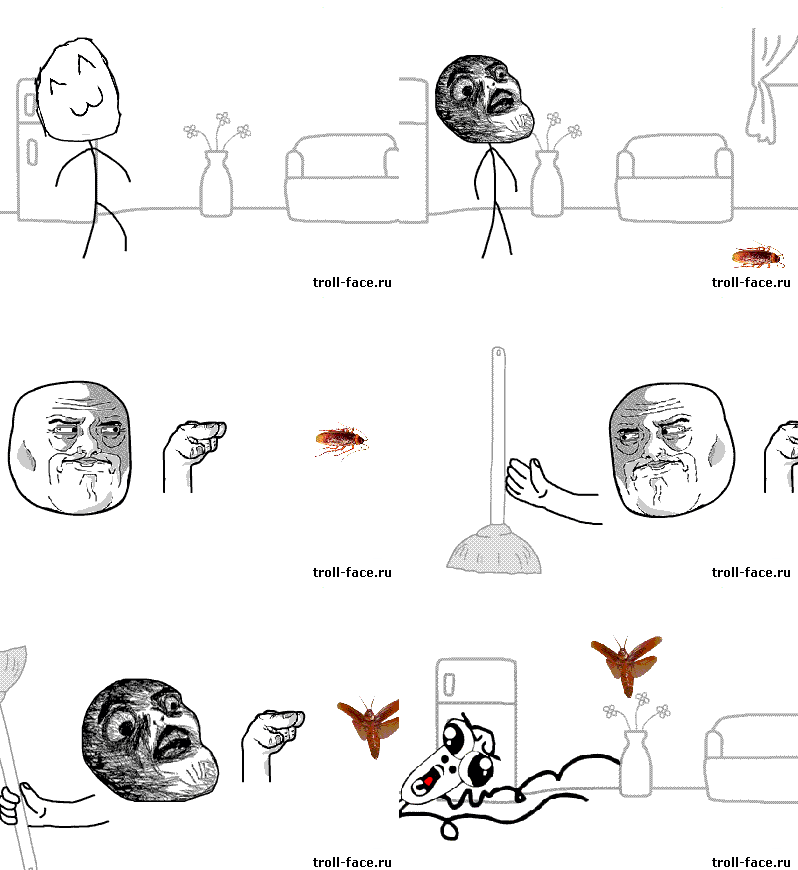
You had to keep an eye on that cockroach, from the other end of the room and pray to God there was only one of them. Which was scarcely the case.
And in the list of beings to keep an eye on, there is also another. Much more terrible. The lizard, the terrible terrible lizard.
Don’t ask why, I just can’t stand them!
It is hard enough that lizards often have those dead reptilian eyes and always make those guttural grating sounds from the corner of the roof to let you know they are watching you when you are trying hard to be oblivious to them. But what is scarier is when unknown to you, they decide to walk all the way, upside down, crawling on the roof, stop right over your head and then blissfully in an amnesiac erasure forget their one superpower, how to stay glued to the roof, and decide to give in to gravity, pretending that falling on your head and into your t-shirt was a happy accident.
Also having a fan overhead doesn’t help the matters.
And oh, don’t get me started on the night the termites grew wings, much to the glee of the lizards. That horrible night, the termites took flight by a thousand inside my apartment, and I happened to have somehow bought the tickets to that annual feast and celebration. I spent the night in a tent inside my blanket, warding off invaders and trying to reach my landlord. In the morning, I was left to deal with the aftereffects of their infernal debauchery through the night. I swooped their wings away as the newly wed couples that survived decided to settle in for the year. The lizards were nowhere in sight. Probably too gorged to stay up.
Did you know that lizards generally don’t have long periods of deep sleep like mammals? Instead, they go into a more restful, inactive state where they remain alert to their surroundings, but their energy levels drop. They might nap or be in a state of torpor, especially if it’s cold, and some species even “sleep” with their eyes partially open. Talk about a horror story.
I have had a mouse problem before too, you know, when I was living in Chandigarh. It was much more sinister in some ways. Because you see, that mouse travelled by the kitchen pipe and also had a fixed haunting hour. Since I was a night owl in those days, I always heard the clanging in the pipes exactly at midnight. That was one punctual mouse. But it had the eerie punctuality of a haunting ghost.
Or maybe I had been reading Bram Stocker’s “The Judge’s House” in those days.
Anyways, that mouse had tasted the freedom of hunting on the apartment grounds and looting my storage areas. And it was out for blood every night. It resented that I was awake at that hour that clearly belonged to it as nature intended and no amount of clanging back on the pipes discouraged its ascent.
Anyways, with time, I almost figured out how to deal with all this jungle madness.
I closed off some of the spots from where the termites had emerged. Sealed the pipe from where the mouse tried to get in. Sprayed a line of control with a pesticide to repel the cockroaches without having to kill them or suffocate myself.
I just stayed out of the way of the lizards.
And I would have won the war.
If they had not called for back up.
Once, I was working at night and heard this low hum, almost imperceptible at first. Then it grew stronger, and I looked up, and at first couldn’t make anything out, staring right into the blinding light bulb, till in a flash I saw their terrible silhouettes as the descended. Wasps!
They darted trying to make headway for my eyes with precision and speed. I covered myself with the blanket and prayed to God they had not infiltrated my emergency camp. Slowly, I could hear their humming again as they glided around the walls with military-like coordination, buzzing aggressively as they swooped through the air, their sleek yellow bodies slicing through the space with deadly intent.
I tried to take a small peek. They were circling, scouting for any sign of weakness, poised for the next move.
But that was not all that was happening.
The pipe in the kitchen began to clang, and taking the rodent’s midnight clanging at the jail bars as a battle cry, three cockroaches decided to encroach over the control line and claimed my room’s floor as their territory.
I was surrounded.
I lost the battle that day.
Of course, I spent the coming days looking for ways to repel wasps. Whoever wrote the article about spraying soap water on wasps clearly didn’t have any combat experience. You cannot spray anything at wasps without turning them into fiery little devils on wings who are willing to go kamikaze on you.
So, when I say I have a mouse problem now, to me it is like trying to resolve a skirmish in the neighborhood as a retired veteran.
Also, I have become too soft now. I almost find the little guy cute.
Anyways, with nothing better to do and trying to avoid the traps, I placed a complaint on the apartment portal. They sent a young guy, who informed us that apparently, the mice had overtaken the middle wall of all the apartments in the building and used it as a sort of travel channel to hunt for food. And the apartment authorities had given in, a sort of peaceful avoidance and denial of the problem. They sent people over to attend to the problem as more of a band aid solution.
Anyways, this guy was dedicated to help us out and ended up closing many of the openings to prevent them from entering the apartment. He commended the clay work we had done to close off some mouse holes on our own. And truth be told, we did not see a mouse for months.
(However, strangely, the water service in the apartment did get disrupted that day.
I like to believe that had nothing to do with the mice mafia.)
Anyways, over time maybe, there was some understanding between the apartment authorities and the whiskered gang to avoid our apartment for some time to throw us off the scent.
But after a few months, of course, the mouse was back.
I knew it, I could sense it for sure. But I was in denial. Those unaccountable shadows in the dark. Those crinkling sounds between the wrappers when it got dark enough.
I just wanted the peaceful times to be back.
I did not lay down any traps. At first, I relied on wishful thinking.
Then I told myself, well, mice have the right to this planet too and they do not believe in paying rent to be on this land that nature intended for them to be on. How brave and revolutionary!
Then, one day, I ordered some ultrasonic pest repellant lights in a shopping spree.
And oh boy, they surely made an impact.
But not the kind I was hoping for.
I woke up the next day and found my peace lily toppled to one side, half of its roots gone, with a huge pile of soil on the floor by the side.
Maybe they went mad because of all those blue light waves.
But I understood, being a veteran. They had left a message for me.
This was an invitation to war.
I was furious! They had done it. They had crossed the line of control.
I made another complaint and the old guy who walked in this time had been in the army.
Exactly what this battle needed.
He wore a cowboy hat, was tall with broad shoulders, sported a bit of a beer belly.
This guy was ready to hunt some mice.
Or something bigger, if the opportunity were to present itself.
He said he had hunted before.
Talking of hare, he mentioned how they were introduced to Vancouver Island in 1960s and tended to reproduce at a crazy speed. And something about the Helmcken highway interchange where people drop off their pet rabbits. I checked it later and this is what I found online:
People in Victoria, BC, have been dealing with an overabundant rabbit population. The rabbits have burrowed under buildings at the University of Victoria, creating tunnels that undermined their foundations. Neighbors have discovered baby bunnies on construction sites, but there is nowhere for them to go. The BC SPCA has limited capacity to house them and requires a specific quarantine due to a lethal and highly infectious rabbit hemorrhagic disease. Non-profit groups like Vancouver Island Fluffle have turned away abandoned domestic rabbits due to the high number of abandoned rabbits they can’t take in. The provincial government is also discouraging people from dropping off their rabbits at the Helmcken highway interchange in Victoria.
I looked over at Chanchal who had bunnies as pets when he was young, (who got eaten by cats, thereby making him wary of cats), and he looked alarmed.
“You know if you ever have extra rabbits on you, a good rule of thumb is to drop them at the pet store,” added the guy as he bent over to look behind the fridge.
And we nodded. Sure, that would at least cheer up a kid looking to buy a rabbit as a pet.
He continued, “Because, after all, they need something to feed the snakes there.”
We gulped. That surely had our attention. I also began to notice something else.
Unlike the last guy, this one had no interest in sealing any mouse holes. That was not his concern. In his books, battles could not possibly be fought by simply building fortresses and praying that the enemy goes away because their favorite joint was closed for the night and decides to order from Uber Eats instead.
This guy was not trying to prevent mice from coming into the apartment.
He wanted them to come crawling. By the thousand.
He wanted them to get trapped.
And die.
One by one.
For eternity.
He was all about laying traps. He placed them in-between the book piles. Behind the couch, under the bed, inside a cupboard. I later used most of those traps to circle my peace lily because it couldn’t survive another attack and to my mind, if a mouse still wanted to go for it, it was asking for death.
Anyways, over the next few days, things kept getting stuck in the traps.
Everything.
Except mice.
First to go was my broom that I had to cut free with a pair of scissors. Next to go was my favorite sock.
And then, one time, it was me.
Don’t ask.
A part of me was glad. I don’t like killing living things.
(Except fried chicken. That is controversial. Sort of a gustatory martyrdom. No comments on that one.)
Anyways, after the last sighting, I sort of ended up making my peace with it.
The mouse has been staying away from my plants. So that’s good.
In a way, we have a roommate now. Also, since Chanchal stays up late into the night, I am glad he has some company.
And anyways, I get the message that if I try anything funny, I am going to hear back from them the next day.
In case you have important information regarding keeping mice at bay, do not respond here because I am sure, they are keeping some noses on this blog too. They can smell mutiny.
Maybe we can find a different ultrasonic way to communicate.
And maybe having a cat can help. Though I seriously doubt that.
It clearly wouldn’t work with cats being cats these days:
Moreover, I might land into more whiskered trouble. I am sure, my tatami and plants don’t stand a chance.
For now, this makeshift peace of bite marks and bits and pieces, continues.
Till the next cry for battle.
-

I want to address a certain kind of preoccupation with knowing the self that has been troubling me lately. It troubles me not because I want to rid myself of it, but because I sense an unconscious belief in the rationality of this inclination that I wish to make conscious.
Often times the things that continue to drive us unconsciously are not inherently bad. [Enter the gut feeling]. But in their being unconscious you invite a risk of forsaking an unconscious intelligence in exchange for a borrowed belief followed by an uncalled-for self-criticism as a result of the failure to act in accordance with that belief. (Or worse, an inability to reawaken the unconscious coupled by a disillusionment with the borrowed belief— the accursed limbo that can terrifyingly last a lifetime.)
This preoccupation with knowing the self comes with a set of habits and behaviors that may come close to being selfish, self-centered, with the act being labeled navel-gazing. But the alternative, the lack of self-awareness can come across as agreeableness. And it is that which makes the world go round, doesn’t it? It is what makes the advertising work, the fear-mongering rule, the propaganda sway, makes the exploitation cloaked as tradition continue to take control, the algorithm echo-chamber continue to ring, and the biases persist while making sure that our inadequacy is fed constantly and remains cashable.
The world today seems to be designed for expansion. Yet isn’t it strange how inevitable is the contraction? It reminds me of the “Monkey’s Paw,” a horror story written by W.W. Jacobs in 1902, a cautionary tale, warning against the dangers of tampering with fate and the unforeseen consequences of getting what one wishes for. We, as a species, wished for progress, longer lives, options, ease of access, and development. We got what we asked for. But we also got more pollution, new diseases, more loneliness, more poverty, and war. It is a give and take. There is always a terrible price to be paid.
My proclivity for solitude developed early on when I realized the impact not being in touch with myself and how I was doing had on me and the people around me. How I show up in the world depends heavily on how aware I am about what is happening inside me. Sure, I can drown this difficult yet necessary conversation with the self in a thousand different ways but in my experience, I would only be delaying what inevitably needs to be done. Luckily, my unconscious unease with any long gaps where I go on without that self-talk is way too inconvenient for me to simply carry on without it. But beware the danger of that feeling being suppressed for too long that it almost dies out. At any cost, never let that happen.
The idea is to expand inwards. And I know that sounds like a load of humbug. But let me explain.
I am sure you have come across these lines a countless time:
To see a World in a Grain of Sand
And a Heaven in a Wild Flower
Hold Infinity in the palm of your hand
And Eternity in an hour
William Blake’s famous Auguries of Innocence. I read these lines in an old brown quotation book my mother had received as a part of her university prize. At the time, I had not read the entire poem but the philosophy behind these lines was the one I was fascinated by early on. It made sense to seek the macrocosmic in the microcosmic. It was like looking at a miniature house, zooming out and then playfully, playing around with it, a low-risk way to test any hypothesis.
I have a distinct memory of all the moments in which I was face-to-face, one-on-one with something bigger than myself. The sky, the sea, the mountains, the pain or joy opening up to swallow me whole. These moments are memorable in being akin. These experiences moved me in a way that started this preoccupation with knowing the self, of being a part of the whole that is both part and whole, like a piece of the sky, fathomable yet as much like a sky as the whole. Here was a propensity for truth that could somehow be monitored, an ocean whose deepest depths, though far from being fully charted, presented some hope of being navigated, the being who with enough experience could be calibrated, I could laugh and cry like a lunatic, unobserved and true. That even in putting forward a deception, I could not possibly deceive. That divine freedom of knowing. Just knowing. The closest you could come to flying. Consciously or unconsciously, my hope has always been that in striving for this, I can somehow understand the world. That if I could see myself in the strongest, the most vulnerable, elemental sense, reduced and enhanced to my essence, that moments like that would open up the world to me and me to the world in a way that nothing else might. Like in a miasma of fluctuating lights, I have a chance of catching a glimpse of something true and honest within myself, if even for a moment.
To put it plainly, I am fascinated by the self the same way a child is fascinated by a snowflake that happens to fall into her hand that she loves because it is that chance part of the whole that she is allowed to be in such close proximity with.
The self is the sample of the world you get to be the most intimate with.
How you show up in the world, the kindness you extend to it, or how much you allow yourself to be exploited because of parts of self you could not accept and hence, give space to resentment, greed, distrust, or hatred, is directly proportional to how much you understand yourself.
But what does it take to know and reassemble the self?
For many of us, our self is a black box that we take where we go. There is no need to open it. We have our name, our religion, nationality, occupation, and goals. And these are enough markers to recognize ourselves. But are these enough?
Or are we just barely scratching the surface, afraid.
The hardest part of knowing your “self” is not liking it necessarily because it is “you.” And that is the mother of denial.
Well, there is a whole wide world out there ready to feed on your inability to sit with yourself in the same room. What happens when you cannot rely on the identity markers outside of you that you thought you could rely on forever? The self doesn’t crumble like a house of cards but our ability to accept it does.
In her 1961 essay “On Self-Respect”, Joan Didion writes about the time she was not elected for the Phi Beta Kappa:
To such doubtful amulets had my self-respect been pinned, and I faced myself that day with the nonplussed wonder of someone who has come across a vampire and found no garlands of garlic at hand.
[…]
Although to be driven back upon oneself is an uneasy affair at best, rather like trying to cross a border with borrowed credentials, it seems to me now the one condition necessary to the beginnings of real self-respect.
“On Self-Respect”, Joan Didion
When we lose self-respect, we lose control and spend the rest of our lives reacting to its injustice and our insecurity, through war and greed.
I have hope in the self. Why? Because we cannot go on to deceive ourselves forever and always. The self is where we are often face to face with the real. Didion writes:
Most of our platitudes notwithstanding, self-deception remains the most difficult deception. The charms that work on others count for nothing in that devastatingly well-lit back alley where one keeps assignations with oneself: no winning smiles will do here, no prettily drawn lists of good intentions. With the desperate agility of a crooked faro dealer who spots Bat Masterson about to cut himself into the game, one shuffles flashily but in vain through one’s marked cards—the kindness done for the wrong reason, the apparent triumph which had involved no real effort, the seemingly heroic act into which one had been shamed. The dismal fact is that self-respect has nothing to do with the approval of others—who are, after all, deceived easily enough; has nothing to do with reputation—which, as Rhett Butler told Scarlett O’Hara, is something that people with courage can do without.
“On Self-Respect”, Joan Didion
The real challenge lies in accepting the self. Think of it this way. The world is out there to sit jury on your flaws, real or unreal, to commend your virtues, real or unreal, often subjectively or arbitrarily. But at the end of the day, when the curtains are drawn and the lights are out, you are your best judge. Because you know yourself in a way, with the intimacy that no one else does. It doesn’t matter what you say. What matters is what emerges in the still quiet moments as you sit with yourself. As Didion puts it, “It has nothing to do with the face of things, but concerns instead a separate peace, a private reconciliation.” No one needs to see those parts of you, but it is essential that you do and when you are ready, come to terms with them. If you were to try to brush them under the carpet, be prepared for the unconscious mind to take hold of them and keep them close and shiny for late night replays like a bloody Gollum from Lord of the Rings.
To do without self-respect, on the other hand, is to be an unwilling audience of one to an interminable home movie that documents one’s failings, both real and imagined, with fresh footage spliced in for each screening. There’s the glass you broke in anger, there’s the hurt on X’s face; watch now, this next scene, the night Y came back from Houston, see how you muff this one. To live without self-respect is to lie awake some night, beyond the reach of warm milk, phenobarbital, and the sleeping hand on the coverlet, counting up the sins of commission and omission, the trusts betrayed, the promises subtly broken, the gifts irrevocably wasted through sloth or cowardice or carelessness. However long we postpone it, we eventually lie down alone in that notoriously un- comfortable bed, the one we make ourselves. Whether or not we sleep in it depends, of course, on whether or not we respect ourselves.
“On Self-Respect”, Joan Didion
Think of your flaws and mistakes as hurt and lost potential. Imagine them like little fluffy chickens who haven’t learned to fly. Now, do you want to feel ashamed of them or would you rather take them under your wing, nurture them, accept them as they are while striving to make sure they grow, even if only to become KFC some day? I got nothing against fried chicken.
If you come to accept your shortcomings and mistakes, no one gets to use them as puppet strings. No amount of advertising, no amount of propaganda can mislead you, cashing in on your insecurities. External criticism cannot hurt you because you have seen yourself fully and understand and accept that you will always be a work in progress and never perfect. And thank God for that (for the same reason we have been spared from eternity.)
For what seemed like the longest time, till my 20s, I felt a sense of alienation from self. Women are often more prone to this, but men are equally susceptible. It felt like I inherited my mother’s own anxiety to be a good daughter and a good woman, simply following what I was told was right without knowing why. Hence, the feeling of inauthenticity continued to creep in. Then came a phase where I invited the world in and that is what took control. One form of being controlled was replaced by another. A new version of right and wrong, beautiful and ugly, good or bad. The judgements kept coming from all ends. I got split into many different selves to continue performing at optimal levels. And surely enough, the self, split into many selves, divorced from the stream that sustains our authenticity, eventually, fell into my arms, exhausted.
At the mercy of those we can not but hold in contempt, we play rôles doomed to failure before they are begun, each defeat generating fresh despair at the necessity of divining and meeting the next demand made upon us.
“On Self-Respect”, Joan Didion
I went through all the phases of blaming and blame shifting, resentments, avoidance, isolation, guilt, shame. I could not say no when I really wanted to because I felt guilt, and I could not say yes because saying yes would mean betraying the needs of my injured self. So, there I was, stuck in the limbo.
It is the phenomenon sometimes called alienation from self. In its advanced stages, we no longer answer the telephone, because someone might want something; that we could say no without drowning in self-reproach is an idea alien to this game. Every encounter demands too much, tears the nerves, drains the will, and the spectre of something as small as an unanswered letter arouses such disproportionate guilt that one’s sanity becomes an object of speculation among one’s acquaintances. To assign unanswered letters their proper weight, to free us from the expectations of others, to give us back to ourselves—there lies the great, the singular power of self-respect. Without it, one eventually discovers the final turn of the screw: one runs away to find oneself, and finds no one at home.
“On Self-Respect”, Joan Didion
We need to be authentic. Being agreeable is not a virtue. Let’s stop commending and encouraging women to adjust, to please, to bend, to be agreeable. I am still in the process of learning to say comfortably what I can and cannot do, want or do not want, and to not guilt trip or judge myself for it. I am critical of myself, sure, but not in a way that I reject myself. For everything I do, I ask myself, why am I doing this? What are my reasons for it? There are things I want to do, those I want to stop doing, but for now the goal I have set myself is to simply be in control of the reason, in the hope of making the unconscious conscious.
To have that sense of one’s intrinsic worth which, for better or for worse, constitutes self-respect, is potentially to have everything: the ability to discriminate, to love and to remain indifferent. To lack it is to be locked within oneself, paradoxically incapable of either love or indifference. If we do not respect ourselves, we are on the one hand forced to despise those who have so few resources as to consort with us, so little perception as to remain blind to our fatal weaknesses. On the other, we are peculiarly in thrall to everyone we see, curiously determined to live out—since our self-image is untenable—their false notions of us. We flatter ourselves by thinking this compulsion to please others an attractive trait: a gift for imaginative empathy, evidence of our willingness to give.
“On Self-Respect”, Joan Didion
Another surprising aspect of this journey which is the one that fascinates me the most is how as you continue to go deeper into yourself, you find yourself woven closer to the people around you in a strange way. You understand the insecurities that everyone feels in a seemingly noisy hall full of people. All it takes is a conversation with one person there. The more you know yourself, the more present you can be for those around you. But also, the more you know yourself, the more you begin to respect another’s need for control and space.
A drop may not feel like much in an ocean. But if you see the little things as keys to bigger things, you begin to understand that in relation to the enormity of the universe, our two hands, are in fact, a perfect fit, perfectly capable of designing the lives we deserve.
-
On days I don’t write, I am constantly engaged in an inner monologue with myself. I find myself repeating certain words over and over again, under my breath. I don’t write them down, I don’t speak them out but I feel their shapes and textures. I see them and they see me. They float down haphazardly like the snow, landing and lodging themselves with differing wills somewhere deep within my haptic sinews. They become the tension I carry with me in my body, the heaviness of it. Often, they do not belong together. They do not make that much sense either. But I acknowledge them.
They wait breathlessly for the moment when I can finally sit down and say sorry, sorry for making you all wait so long. And I let them rest here, making a little home, lighting one small fire, this one lamp standing tall beside the dark icy street. Something to hang my coat on for now. Before I have to move again.
All this time away feels like holding my breath underwater for a long long time.
When I write, I gasp, I surface.
I breathe.
For as long as I can remember, I have loved words. The stranger they are, the better. I misspell them, mispronounce them. Misread them. But I love them. When I had barely learned to write, I was convinced that I too had every right to make my own words. (No wonder I was bad at spelling.) When my husband catches me misspelling or mispronouncing a word, knowing that my love for reading and writing is only self-professed, I do feel schooled but grateful. (It is his way of expressing his love for language and me.) I try to pronounce them correctly and say the incorrect word by default the second I get comfortable. But it does not change anything about how I feel about words. How I have always felt about them. Like kind mothers, I believe they don’t mind me playing around with them. As long as I can bring my child-like wonder to the game.
I like describing things as I write. I like the feeling of not being rushed into saying something or into voicing out any tender thoughts, not fully formulated, which are so quick to recede when open to immediate contradiction but blossom beautifully when watered and given time. I like the sensation of being able to mull over them. To revisit. To reflect. When I speak, I tumble over silences, nervous, filling them up, making up for emptiness, and all my words come out jumbled. But when I write, I am alone. There is no one here. I write as one would write a letter. I think of you, reader, as being kind. I think of you thinking about this, only in retrospect. I feel I can, with the first snow, gently, in the early morning, leave this letter under your door and walk away, as silent as I came. If you were to catch me as I do, you would find me running away like a madwoman. Laughing and crying. Thrilled that I got to say all this to you without having to deal with the consequences of speaking my truth in the moment.
Most times, that has worked in my favor. But sometimes, it has been a detriment too. I have loved words for the sake of loving them. Playing with words is sort of like playing with fire. It is fine as long as you don’t hold them too close to your skin. The writer risks going close. No wonder most of us only write about the past. Writing while your house is on fire is not everyone’s cup of coffee. You only visit through your mind, in a memory, and even then, never entering but as one would observe from keyholes, looking underneath doors, at the heads and feet of monsters that still proll in those corridors.
But you know what?
Don’t take my word for it.
If you know what I mean.
“Death is like a mirror in which the true meaning of life is reflected.”
Sogyal Rinpoche
The past year has taught me a lot about myself. I realized I am not nice. Not at all. And I don’t have to be, all the time. But I am good at heart. And I mean no harm. I am beginning to find who I am when nothing else holds. How nothing else will hold but truth. How we only do have the present. How there is nothing ordinary about life at all. How there is no one way to grieve.
What all I can survive.
“The reality is that you will grieve forever. You will not ‘get over’ the loss of a loved one; you will learn to live with it.”
Elisabeth Kübler-Ross
The weather outside is misleading. But I am a veteran now and won’t be fooled again by the sunlight peltering through the curtain chinks.
I am walking through a dangerous phase in life. More like brisk walking. As one does in the dark, denying the fearful miasma that is only one step behind. And I am not running. That would be admitting I am afraid. And I am afraid. But I won’t say it. I have bundled up all of my feelings into a tight fist, severed it, and placed it deep inside a hole in the wall. And I never look at it.
I can see it from the corner of my eye but never look at it.
I cannot deal with it.
But not a day goes by that I don’t sense it. It is still there, growing, gnawing.
When it gets too much, I try to shed my skin and be someone I am not. I bemoan the fact that I am not like one of those reptiles who hold the ability to do so. It helps me tremendously, or at least I am under the impression that it does, to not feel what is my share to feel in this world. I don’t want to hold on to the layers of what I accumulate every single day. I am beginning to think of myself as a new character every day, every moment. I am not her. All of this is happening to her and not to me. She is not nice, but I can be. Every time I act out, it was her. Not me. I try to dust myself off every single morning. But I can see myself reflected back in the eyes of those around me. I am still her and I am growing like a monstrosity.
I will be honest.
I cannot hear my father’s voice again. See? Even as I write this, tears, ready to well up and drown me, dangerously hover over my eyes. I have learnt to tap my finger when it gets too much, and I need to push it all back in. I am not well, and I know it.
I cannot hear his voice again like I used to. Playing it on repeat. I can look at him in photographs but am too afraid to do it for too long for as he becomes real again so does his absence.
I will never be whole again. I marvel that I am still here, going on like before. How does one live with something like that? Knowing that the person you hold dearer than life can one day live on without you as can you. Can anything be more cruel and kind in nature? I have been spared and yet I am in hell.
So how do you go on? How do you tell your mother to go on?
How words like “Mom, why don’t you read all the books you were planning to read? Why don’t you watch these series on Netflix to while away time?” taste like sand in my mouth even before I have uttered them.
I feel like we are some dumb animals caught inside a trap without a way out. We can shriek all we want but nothing will change. And if nothing will change, nothing matters.
And yet, everything does.
I know now more than ever before the value of the present. How important it is to live your life, in the present, as happily as you can, with the people around you. When I see the mute cherry trees, the grey sky, the sunlight falling on my notebook, people walking their dogs or children or both as the case may be, a routine message on my phone, three mugs to pour the coffee I made into, or even my own hands, I know now how precarious it all is. How everything can disappear at any moment.
All it takes is a heartbeat.
“Death is a challenge. It tells us not to waste time… It tells us to tell each other right now that we love each other.”
Leo Buscaglia
And so, with a vengeance, I am trying to embrace life.
With a vengeance, I am trying to be the backbone of my family, suddenly so small, so vulnerable.
I know I am being selfish.
I know I am afraid.
“The fear of death follows from the fear of life. A man who lives fully is prepared to die at any time.”
Mark Twain
I am someone sitting in a cafe, sipping on coffee like everyone else, but forever ready to brace myself for impact, at the fall of a leaf.
Make yourself familiar with the belief that death is nothing to us, since everything good and bad lies in sensation, and death is to be deprived of sensation. … So that most fearful of all bad things, death, is nothing to us, since when we are, death is not, and when death is present, then we are not.
Epicurus
Yet, in all of this madness, there is some grace.
For one, I am beginning to see how everything is one. I am one. Sure, some days I am running forward busily, irritably trying to keep up with time like a river. Some days I am tumultuous and messy like the sea.
Other days I am a lake, still and dark. Waiting for myself to happen.
Other people are me too. I can see we all essentially cry for the same reasons.
There is very little that differentiates us from trees, in matters of life and death that are bigger than us.
One divide did arise though. Not with respect to the trees but with other people. I sense that I am unable to empathize with the day-to-day sorrows and tediousness that plagues people. That is not to say I am above them. I still complain and bemoan over little things that further aggravate my feeling of being generally unwell in the world. No amount of material comfort can make up for it. Beyond a point, it only ever makes me feel restless. But I do sense that I have lost the ability to feel sorrowful for people who are not grieving or in dire situations. I want to scream at them that they are absolutely fine. I want to say you have everything you could ever need to be happy and well. You should be out celebrating. You have your family, well and alive. It is all right there. You don’t need much to be happy really. And when they cannot see it, which is understandable (I was there too), I find myself feeling helpless and enraged.
This is a weakness that I will profess is a work in progress. I am not sure if other people like me feel this too.
Knowing that my time here is finite, makes everything around me either meaningless or even more meaningful. I seem to oscillate between the two from time to time. I do not know which is right. I try to make it the latter but not all days are alike.
“The boundaries which divide Life from Death are at best shadowy and vague. Who shall say where the one ends, and where the other begins?”
Edgar Allan Poe
“For life and death are one, even as the river and the sea are one.”
Khalil Gibran
What amazes me is that we have built such a humungous world, a huge civilization, and yet there is not enough space in it for death and grieving beyond the initial and necessary ritual of it. As if what comes after, what is invisible to the eye, is not there at all. How can that be? We think it won’t happen? It doesn’t happen? But we all seem to be brisk walking and waltzing our way through these woods of our own making. We deny so much every single day. All of us, trying to run away from something or the other that we know to be true but would hate for it to be true. So, we do the only thing we can do which is to not acknowledge it while knowing it. Most of our troubles seem to stem there.
The past and the fact we cannot change it has a new meaning that it never had before. To know that no one can take the time I spent with my father and our memories away from me. That it happened, that he was my dad, and it can never be undone— even by a God. That is something I hold dearly close.
“What we have once enjoyed deeply we can never lose. All that we love deeply becomes a part of us.”
Helen Keller
I do know that death is peaceful. I know it because I see it everywhere around me, in the falling of leaves, in the setting of the sun, the melting of the snow. And you might say, but they come back. Over and over again.
And I believe, so do we.
We change forms, but we never cease to exist. Because we are all one.
And that is my religion if any.
“Death is not extinguishing the light; it is only putting out the lamp because the dawn has come.”
Rabindranath Tagore
When grieving, nothing really helps. Well, at least not at first.
Medicine/ science/ books/ conversations/ language. Everything fails.
So, you only try to sustain somehow. For what is still left.
The first thing that calmed me was looking at the snow laden trees lining the road, knowing something of my pain and the world beyond this one, standing still, suddenly in such stark relief next to the busy traffic on the road. It seemed like I had been flung all of a sudden to their side of the world. The world had quietened for me all of a sudden and I could see what mattered the most. Almost like the essence of life had been revealed in its absence.
“Death is the veil which those who live call life; They sleep, and it is lifted.”
Percy Bysshe Shelley
Yet, indoors, it was quite another matter. I remember, in the desperation to clutch at something that could help me breathe, I turned to books on grieving on my way to the airport. Did I read any of them? I tried to read one and failed miserably. It was too soon. I tried to take it too fast, to be someone my mother could rely on. It didn’t work.
So, I wrote. All the way. I wrote. And I cried.
I cried with strangers who had walked through the same path. Everyone around is carrying stories of loss. You would be surprised. It only takes one person to be vulnerable, as I was on that flight, and everyone opened up. My raw pain gave them the strength to look back at their own painful memories and become my source of strength through that time. This change overcame me too as I walked into my home and saw my mother. I became her strength, and she became mine.
With time, when I was ready, music found its way to me.
At first, overwhelmingly, then slowly, I opened up to it.
It happened one day in a Japanese garden. Someone played the piano unexpectedly at a place I had a shared a beautiful memory with my family only a few months before. I felt the music swelling and taking form around me in a way I had never experienced before. I remember listening to the chirruping of a little bird and feeling like it was somehow connected to my father and that he was trying to reach out to me by being present with me in the moment too.
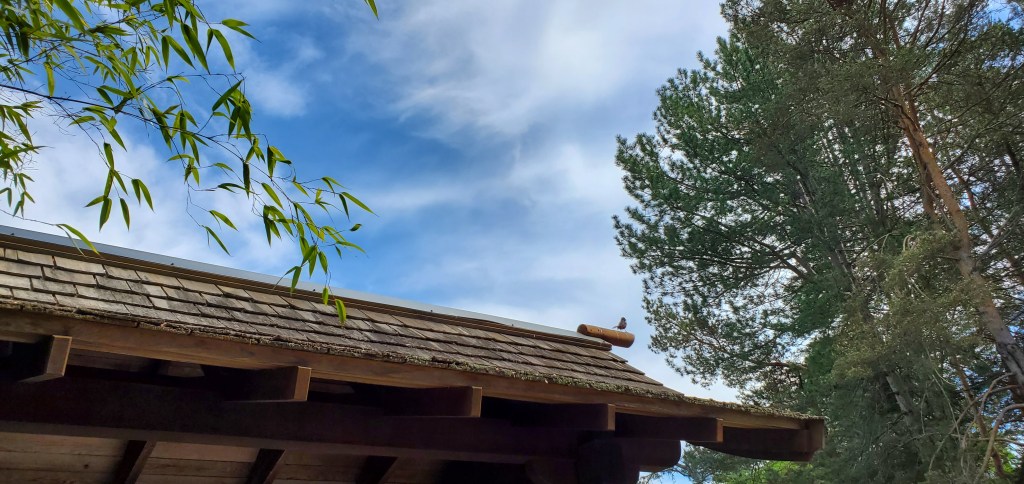
Here was someone, leaving to get treatment, playing such a beautiful song, through their own sorrow. It brought me strength, beauty, and grace to be a part of that moment, to take courage too. Something does tear at my heart every time I listen to this song but now, I know all that stirs inside me is born of love and past happiness and that I am glad it was there and that those days will continue to remain golden as they were, even if in the past. “Grief is the price we pay for love.”
Queen Elizabeth II
I thought I would never be able to bear music and yet music has been the biggest gift my dad ever gave me. What moves me when I listen to music is a part of him, I can feel that with every ounce of my being.
As time went on, language came back. Unsurprisingly, poetry came before prose did. Poetry saved me. It really did. My mind had shut itself to all logic and rationality, but poetry was what made its way to my heart. It did not deny me my humanity. It did not deny me my madness, my hesitation, my extremities, my ugliness. It was messy and I could feel at home in it.
Poetry reaffirmed that not being able to let go of grief for it is a part of what you lost is normal. I have tried to trudge my way through it, in a hurry to leap to the other side, but every time I take a few steps it feels like I am leaving him behind in time. It is only now with time that I am beginning to understand that our love, our grief never leaves. We move forward, carrying it close to us. And that too is a form of love.
Grief
by Barbara Crooker
is a river you wade in until you get to the other side./ But I am here, stuck in the middle, water parting/ around my ankles, moving downstream/ over the flat rocks. I’m not able to lift a foot,/ move on. Instead, I’m going to stay here/ in the shallows with my sorrow, nurture it/ like a cranky baby, rock it in my arms./ I don’t want it to grow up, go to school, get married./ It’s mine. Yes, the October sunlight wraps me/ in its yellow shawl, and the air is sweet/ as a golden Tokay. On the other side,/ there are apples, grapes, walnuts,/ and the rocks are warm from the sun./ But I’m going to stand here,/ growing colder, until every inch/ of my skin is numb. I can’t cross over./ Then you really will be gone.
I slowly learnt that there would be days when grief will overtake my life. And I have to be gentle with myself and those around me when that happens. It is a feeling that demands attention and I have to open up spaces in my life to let it be. It is also an act of love, to be able to look at what hurts and to acknowledge that pain. Something cruel and terrible has happened. The world did not stop because it did. When the man working at the bank crossed off my father’s name from the register offhandedly, I know the amount of strength it took for me to somehow bear that by sparing my mother the sight and then carry on as if nothing had happened.
Grief
by Matthew Dickman
When grief comes to you as a purple gorilla/ you must count yourself lucky./ You must offer her what’s left/ of your dinner, the book you were trying to finish/ you must put aside/ and make her a place to sit at the foot of your bed,/ her eyes moving from the clock/ to the television and back again./ I am not afraid. She has been here before/ and now I can recognize her gait/ as she approaches the house./ Some nights, when I know she’s coming,/ I unlock the door, lie down on my back,/ and count her steps from the street to the porch./ Tonight she brings a pencil and a ream of paper,/ tells me to write down/ everyone I have ever known,/ and we separate them between the living and the dead/ so she can pick each name at random./ I play her favorite Willie Nelson album/ because she misses Texas/ but I don’t ask why./ She hums a little,/ the way my brother does when he gardens./ We sit for an hour/ while she tells me how unreasonable I’ve been,/ crying in the check-out line,/ refusing to eat, refusing to shower,/ all the smoking and all the drinking./ Eventually she puts one of her heavy/ purple arms around me, leans/ her head against mine,/ and all of a sudden things are feeling romantic./ So I tell her,/ things are feeling romantic./ She pulls another name, this time/ from the dead,/ and turns to me in that way that parents do/ so you feel embarrassed or ashamed of something./ Romantic? She says,/ reading the name out loud, slowly/ so I am aware of each syllable, each vowel/ wrapping around the bones like new muscle,/ the sound of that person’s body/ and how reckless it is,/ how careless that his name is in one pile and not the other.
I am a woman clutching with all her might at what I have left. I am trying to fill up all spaces, with words, with material things, with food, with work. And I am burning out profusely, too quickly for my own good. I have become dissociative. I am often in denial of my own feelings. Or lash out. Even writing about this today took a lot but was something I had to do, for good. I wish to somehow find ways to put things between me and the feelings that I find hard to process. And that is okay too, for the time being.
Grief
by Erica Funhouser
I try to impose/ the static beauty/ of what remains,/ like the one utensil/ in an auctioned drawer,/ upon the cluttered truth/ of what is gone,/ not even gone, but going./ I try to keep my mind at noon/ at least as long/ as noon lasts,/ the length of the firehouse whistle,/ the full reverberation/ from the forest,/ the final couplet/ spoken by the flicker/ hammering for grubs/ in fallen hemlock.
I know that it is often hard to understand, the different ways someone finds to mother their own grieving. But they are all valid, as long as you harm no one. As Neil Weis wrote, grief can also be dormant, an entity in itself, frozen, concrete and real, “a horse in the mind named sleep,/ erect in a city where spires spit birds/ and grief holds, never bursts.” There is no right way. If it is happening to you, it is already normal. Do not look for any other experience to validate it, but your own. Grief triggers the deepest recesses of our psyche. It can never be expected to be neat.
And if your grief is neat, that is okay too.
Grief
by Raymond Carver
Woke up early this morning from my bed/ looked far across the Strait to see/ a small boat moving through the choppy water,/ a single running light on. Remembered/ my friend who used to shout/ his dead wife’s name from hilltops/ around Perugia. Who set plate/ for her at his simple table long after/ she was gone. And opened the windows/ so she could have fresh air. Such display/ I found embarrassing. So did his other/ friends. I couldn’t see it./ Not until this morning.
I hope these poems can do for you what they and many others did for me.
Life finds different ways to teach you how to swim. I am grateful to have some really brave and loving people around me who ensured I didn’t drown.
They have been my oxygen all the time I have been underwater.
I am not ready to come out yet. Maybe I never fully will.
But I can sense this now. I feel myself slowly surfacing.
Not gloriously, oh no.
Grief is bringing with it a lot of other things to the surface, many other not so great pieces of this elaborate puzzle into its fold. But at the heart of it all, I am rediscovering what it means to be myself, as authentic as I can be. I am in the process of taking roots like an oak tree. The process is rhizomatic and crazy. I am forming, steadying myself. It is harder than it sounds. The world has drawn these grids around us for an ideal life and it is anything but ideal when it plays out. As I form, I will cross some of those lines and bleed onto them with my brilliant blues. And that should be okay.
Life is definitely a tragicomedy. And if I have a part to play, I need to make sure that the one who shows up on that stage, no matter what the role, is me.
Because now is the only moment given to us. And this will forever be the only moment to speak our truth.
-

There is no other way around it. My sweetest dad will no longer be making another cup of tea, wearing his slippers again, painting another picture, singing another song, dreaming another dream. His clothes still smell of him. They are still hanging by the door. The way he left them. His shoes too, with the socks rolled in them. His turban still retains some of its shape from when he wore it last. Yesterday I found how my mother had placed his summer clothes in his closet, like any other year after the end of winters. His toothbrush is in the stand. We are still using some of the grocery he last bought. I have taken to brushing my teeth regularly at night, switching off extra lights around the house, cleaning my mother’s car in the morning in his place and watering the plants. It soothes me like nothing else. In that moment, I am him. His clinic is the same. His glasses are still on the table, his last signed medical prescription for a patient, open. I feel his presence but I want him to talk back. There is no way around it. I feel like for the first time in my life, I have been completely cornered. That no amount of hard work or prayers, anger or love, can bring him back. Lately, I have been thinking of time machines and resurrection. Parallel universes. Not kidding. I am serious. I want to be an exception but everything screams that I am not. There is no way around it.
I have tried talking about him. Especially to him. I feel he is the only one who can help. Can you believe that? Only his help will do to deal with his absence. One night before my flight after I got the news, I almost called him to ask if I needed to keep any medication to deal with claustrophobia on the plane. For some reason, he always kept packing extra ORS packets for us all. I remember joking about it a week before he passed away.
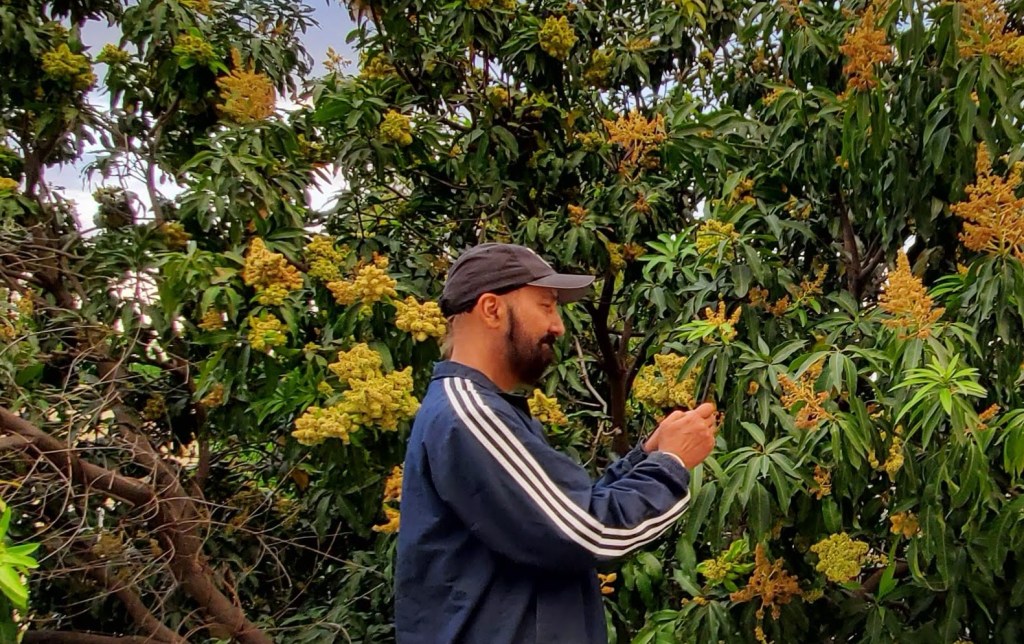
We have a mango tree growing outside our home. During the lockdown, he was always taking pictures of its blossoms. This year too, he was so excited about the mangoes. Even now, as I write and look outside the window, the trees and plants seem to embody him more than anything else. This year, no one managed to pluck out the loquats. I saw squirrels with their tiny hands and birds with their small beaks biting into them. I knew he wouldn’t mind. Even before, he always left some loquats and mangoes hanging for them.
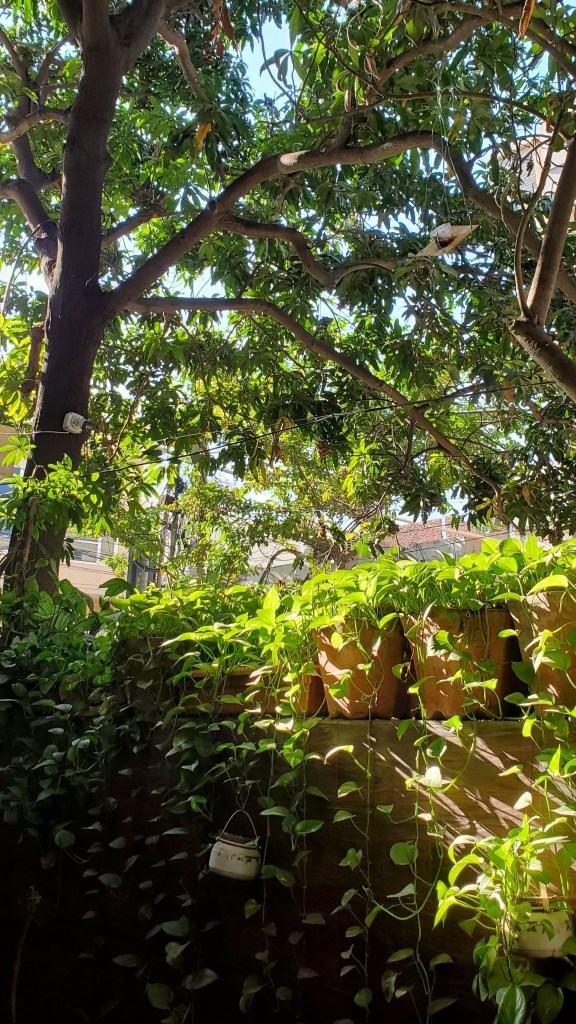
My father and I are/were different in so many ways. He was the life of the party, I see people and run in the other direction. I like to read, he didn’t. He wanted onions in his omelet, I don’t. He mixed ice cream with Gulab Jamun, and I don’t even know where to start with that.
But our souls are made of the same stuff. And though past and present tense divide us now, we continue to co-exist.
And sometimes, when I look closely at my hands, I see his hands there too.

Yesterday, while attending a meeting, I caught myself doodling and ended up drawing the first flower that my father had taught me how to draw, years back. I had not forgotten it. Four pink petals shaped like hearts around a circle. Even now when I think about the time I got angry at him for entering my room during an online meeting or got irritated with him for not understanding the simplest function of his new phone, I feel that even then my mind had stored away the memory of that first drawn flower somewhere. I just wish I could have remembered it sooner.
I recall how there was always fruit in the fruit basket on our dining table. I remember how he would come back from the office, hang the car keys by the door and put the fruit on the table which he would cut in the evening and place before us—me, my brother and my mother engrossed in a serious study session. Mostly only my mother was engrossed. We never failed to send a distress signal to dad to save us from mom’s fury that would inevitably erupt at any moment.

I remember those sunny winter days, how my father would bite off chewable pieces of the sugarcane for me and my brother. Sometimes it was oranges sprinkled with salt. Less popular was his method of splitting the banana with a knife covered with salt that would start oozing. He loved dozing under the winter sun, covering his eyes with his parna, his feet moving of their own accord at the slightest disturbance. We giggled uncontrollably at that.
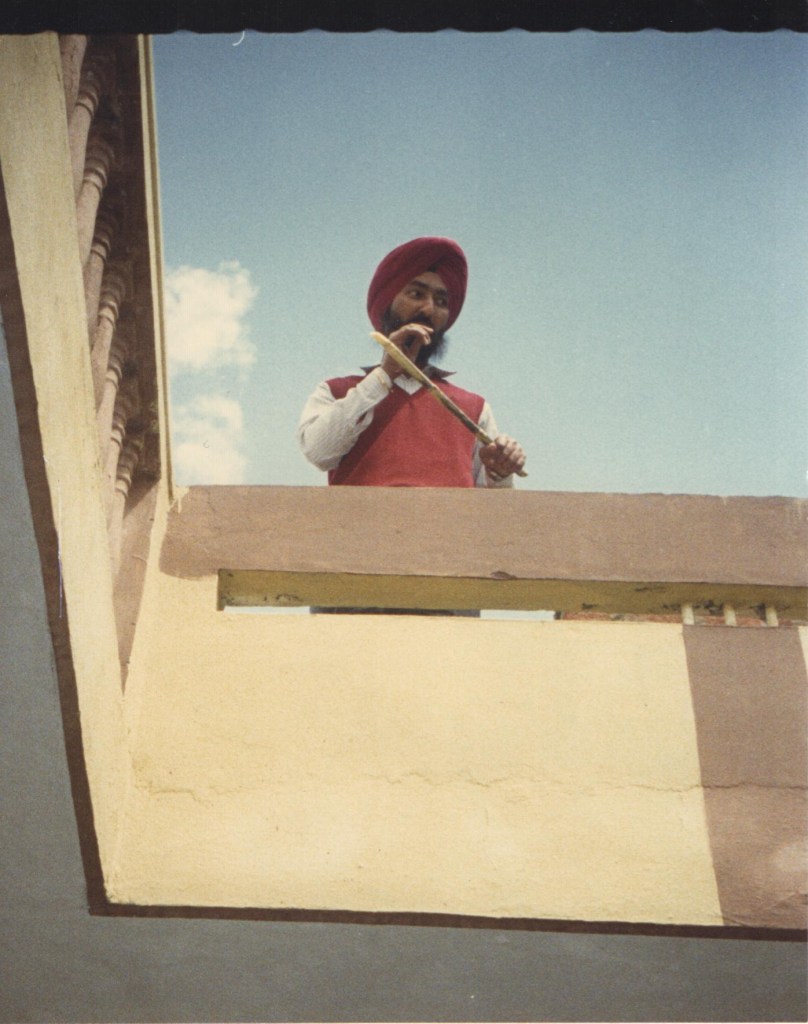
As a kid, the sound of his scooter never failed to make me run to the gate, joyous that he was back. Later in life, he did not mind driving my pink scooter. Or using my old study table covered in stickers for his clinic. Or my old poster-covered closet. He was still making use of old sweet boxes to store his paint brushes. He was always utilizing what he had at hand. He even devised a way to pluck out the fruit without damaging the trees using old plastic bottles. Made a painting on blank backs of wedding cards, used old boards to create shelters for baby birds to save them from the stormy weather, made his own easel. We rarely had to call a carpenter or an electrician. He took pride in doing things on his own, silently, before a problem became apparent.

Silently too, he held the invisible burden. We did not see it. He was always behind us. Always out of sight but elemental. Our backbone.
The house too is falling apart now, without him.
I never thought he paid so much attention to what we said, offhandedly. In Canada, we usually get milk in cartons. I had forgotten about milk packets. During the course of making endless cups of tea for everyone recently, I learnt that my father always told my mom to cut the milk packets diagonally. To never cut off the tip because of what I had told him years back about the environmental concerns that could cause. And I had forgotten all about it myself. I had also told him to buy frames that opened from the back so that he could rotate paintings he wished to display every season rather than getting them all framed. He had told me they did not sell those and the ones available online were too expensive.
And there they were, incomplete wooden frames, sheets of glass still neatly wrapped that we had to send back. He was actually thinking about making them on his own! And they were looking so good. We kept the frames. There is this one painting that he made and framed fully by himself which he placed in the clinic. Now it lies at my mother’s dresser. She looks at it daily while getting ready for work. Once she asked him to paint some purple tulips for her, purple being her favorite color. We found the footage on the CCTV camera, of my father drawing something a day before. We found it later, a canvas, hidden behind the other completed paintings, meant to be a secret project. A pencil sketch of tulips. Flowers, without color.
I see it now, my father’s growth as a painter. From his painting from the initial days that is taped to the wall of our washroom to his most recent one that was still on the easel, the blue sea, the paint not even dry that got on my hands later as I was clearing his art supplies— I can see how we took his growth as an artist so non-seriously. And how he stayed with it. Kept painting. Through hours of loneliness.
Hours. Precious hours. That I could have talked to him in. Shared all that now haunts me.
But you see, I never could see him as an artist. To me he was dad.
So I love his painting pasted on the washroom wall as much as his last.
Last time, when he came to visit me, he was pensive. His knee had been troubling him. Just when he had the time to finally take long walks through the forest trails or at the beach, his legs were giving way. I sensed he was depressed and coaxed him. You are the youngest of five siblings, why are you so worried about growing old?
Looking back now, my mother thinks he knew.
I have a new winter jacket lying in my closet to keep him warm in Canadian winters. There is a new backpack with the tag still intact that I asked him to buy for traveling. There is a bag half full of clothes and things my parents were planning to use when they came to visit me and my brother. That unfinished painting of tulips that my father left behind. Packs of his favorite granola that he bought only a few days back.
If you ask me if he knew he would be gone so soon, I would say I don’t think so.
When our parents came to visit me and my brother in Canada, we were so vigilant. It seemed as if our roles were suddenly reversed. We guided them with everything, being more familiar with the country even though my father was more well-travelled than us. We hushed them when they spoke too loudly over the earphones in the bus, listening to old Hindi songs. We reprimanded them if they walked on the wrong side of the aisles or hesitated while crossing the road when the green light turned to a countdown. We chose the best time and place to buy fruits. Once, my mother broke down into tears because we told dad not to buy apples even though he had carefully handpicked the apples he wanted to buy and had placed them already in a bag. They felt it deeply. I was careful after that one incident to tread sensitively around their feelings. I began to care less about what other people would say or think. Later that year, I called dad and told him how my brother and I rode a chair home, taking turns to sit on it, pushing it down the road outside. I remember my father laughing and saying that he was so glad we were finally comfortable enough in that country to do that.
He was back in India when it happened. But for the months he lived with me in Canada, I remember him cooking for me, making roti with sabzi, waiting for me to be back from work and spending that time painting. And even when I was home with him and it was time to eat lunch, I took mine to my room so I could watch something I liked while he watched news or saw videos on his phone. I did that all the time. Why didn’t I sit with him more often? Why didn’t I eat with him more often or talk to him? Why didn’t I hug him more often?
Why didn’t I tell him I loved him more often?
Sure, I thought I had all the time in the world. But would even a 100 years be enough?
These days it is winter indoors and summer outdoors. It rains a lot too lately. Every time it rains and the breeze floats in, I miss him terribly. I know how much he relished this weather. How he had a song for every rainy day.
I ache for him when anything beautiful comes my way. I am almost grateful for the pain knowing that he will not feel it.
My father used to wake up at 5 in the morning
Smelling of muscle pain sprays and toothpaste
Covered in pads, bands and appendages of varied kinds
He went and brought back home sweat, energy
And hardened hands from playing volleyball.
My father showed me his chipped tooth
His bone injury, his finger deformities, like relics
Others with bellies like pouches, came to play,
Bringing dogs and laughter, and complaints
And I wonder what my father said in return
And though I was old enough,
My father woke me up daily
With the warmest glass of milk.
Now in lockdown,
My father wakes up at 9 to workout
His clinic has turned into an art studio
Of which come daily a stream of songs
And celebrity sketches
That he uploads on Instagram
(I showed him how)
Throughout the day, he finds nooks and corners
That need fixing
And paints discarded yogurt containers
For growing money plants
The house turns greener and the mangoes grow
Unsaid he waters all the pots and trees
Listening to the radio in the kitchen
He makes the best cup of tea
Without fail
Every evening, no matter how hot it gets
He goes to the terrace and brisk walks
And plays tennis with the wall
The house rings with the sound of the ball
And the songs grow sweeter
With the summer smelling of mangoes.
After his retirement, my father always waited for my mom to have the evening tea together. Around 4:30, he would start pacing near the gate, sometimes watering the plants. He opened the gate before her car was even in view. Taking my mother’s lunch bag in his hands, he ushered her in, listening to her narrating how her day was. Then he made tea. He loved making tea with jaggery in it. I still remember his singing voice wafting from the kitchen. The tea box is still there. Opening any containers that he had last closed makes her break down and cry. For my mother, coming back home from work is the hardest. When she walks to her car, she is no longer thinking about retiring this October to finally have some time to spend with dad. Sometimes, I call her on her way back from dad’s phone. It seems to comfort us both in some way.
Yesterday, I saw all of my old identity cards from school days, neatly packed in my father’s almirah. A note about my first school day. My first day at my job. My childhood drawings were still pasted outside the almirah. I found a list of films he had recently watched and his to-watch list noted in a diary. A list of hashtags and instructions to download his karaoke songs that I told him about on the phone. Two days before he passed away, he messaged me on WhatsApp. It was a regular cleaning day at my home. My mother and father were thinking of renting out the upper section of our home. My father sent me the picture of an old doll’s shoe, covered in dust. He wrote, “Ruhi, your doll’s shoe.” Like some of the other messages he had sent, I glanced at it briefly and forgot to reply. Two days later, I got a call that he had passed away from a sudden cardiac arrest. In the days that followed, that shoe kept coming to mind. At home, I kept looking for it subconsciously. Ultimately, I ended up asking my mother if she had seen it. She told me that most probably it had been disposed off. Before throwing it, my dad had taken that picture and sent it to me. So the picture was all I had for the moment. A few days later, there was a storm. As it started raining, I ran upstairs to retrieve the clothes that had been hung out to dry. The rain smelled different. The leaves of the vine danced and tried to shake themselves free but were subdued by the heavy drops. Something made me look closer at the base of the terrace where a few odd trinkets were always kept and there it was, my old doll’s shoe, all cleaned up. I don’t even remember the doll it belonged to. I don’t remember so many things about my childhood. All of it nestled inside my father’s heart that I was not careful with when it was still beating. All I could do was hold on to the shoe that my father was unable to throw away.
Every time I look at my mother’s closet, my heart breaks. She has a note there, pasted on top. “Ruhi and Noor are happy and doing well. Chanchal and Ruhi are happy and well.” Her notebook is filled with her prayers for us. She wonders why god did what he did. I doubt there is a god. And believe me, it is a kindness when I say so. Which god would want to take the blame for all the pain in the world? I would rather think of natural forces and their arbitrary fury. Does an earthquake analyze the religious beliefs and good deeds of people before striking? Do I look at an ant’s life’s work before stepping on it? It is simpler for me to make sense of things this way. One continues to do good not out of fear or for the rewards to come. The gift comes with the deed, in that moment. The punishment of doing bad too comes with it. The heaviness that settles within your heart, making it darker.
For me, religion was not god but looking at my mother and father from the side as I placed my head on the carpeted floor to bow, it was cuddling next to my mother and then hopping away to my father as they sat in the Gurudwara, it was walking together on the cool marble floor warmed slightly by the winter sun, it was placing the piping hot parshad in my dad’s hands till it cooled down. It was the fragrance of besan and alsi that smelt like my parents’ affection for each other and for us, wafting through the kitchen as they both stirred the pots, adding almonds, making round ladoos with their cosy hands. Even when I went to hostel, they always sent a big box for me for the winters.
My father lived entirely in the present. Always. He was always aware that life was short. That the present was all we had. And that is how he lived. But for me, I feel that my life has wrapped itself up in the past.
I feel like a multistoried house shaken to its core by the earthquake. Every day since that day, one of my room collapses. A room I did not know existed. It’s almost as if pain is taking me on a tour in my recesses. Showing me. This. This hurts. Look here, this here hurts too. Because it was real. There was love. It happened. Do you remember that time when? He was there. He is still here but not in that same way, you see? He won’t answer back. No new dad jokes. No new bad selfies. Those stern hugs that never failed to reassure me while putting me back on my feet over and over again. The way my sobs ebbed away while hugging him till I was calm like a lake. I try to imagine him back into existence. In some ways, he feels even more real now. Closer too.
My entire life seems to have been forever divided into before and after. Nothing changed on the surface. But everything changed from the inside. A world has been put to sleep inside me forever. A new one is awake now. A world that lives to self-destruct. Looking at the storm, hearing the thunder, feeling an earthquake seem closest to the new normal. It is the regular days that scare me the most. When the world continues to move on. The way I continue to eat, sleep, work and laugh. This is the actual horror story. My mother, father, brother and I were more or less the same person. I sometimes feel like we died too and this is another lifetime. I am afraid of all that spiritual bullshit. How everything becomes one. How the hell am I supposed to find him later if everything becomes one? I better be reunited with him when I die or rather get switched off completely. Till then, I want him to live through me.
I want to believe he is here, around me.
I have been reading a lot about near death experiences to learn more about death. After all, one of the people I love recently moved to that world. So of course I am invested. I want to know if he is safe and happy and at peace still. I can’t help it. For all the skepticism, I want to fervently believe. I have convinced myself that I can will him to exist. That I can create my own sense of time, reality, in my mind. That time and space can be what I want them to be, inside my mind. But I am not always so clear-headed. More often than not, I am like a baby, crying for things to be otherwise, stamping my feet, hitting my head against a wall that refuses to give way to sense and meaning. Death feels so absurd. His absence makes no sense to me. For someone who loved life so much. Our small little world. We were too ordinary. Too unremarkable. Too non-serious. For something like this to happen. You see what I mean? The things we were joking about only a few days back. It makes no sense when I lay those down next to what happened.
I think I romanticized death a lot before. Rationalized it a lot too. In reality, it is not a concept. It is far too personal. I can’t even call it death. I don’t know how to explain it except that my animal mind is losing its shit. I feel like a mouse caught in a trap. I am panicking daily. I can’t understand that the clenching of my hands and teeth, that nervous feeling in the pit of my stomach in the evenings are there because dad is being awfully silent, awfully missing from conversations, awfully absent from backgrounds, no longer seen or heard around the house. I am unable to send things to him, feed him anything, watch a new movie with him, introduce him to anyone new, tell him about anything that happened today. He is no longer answering his phone, using any of his things. No longer annoying me. He is not helping us in any moments of crisis which seems so unlike him.
People come and go. Language languishes in the corner. Their words float over my skull like fruit flies. My mind is like a completed jig saw puzzle board that caught fire right before the last piece was placed— What the actual fuck?! Language does not move me anymore. I keep words at an arm’s length. Even now. I feel the uselessness of this. Except that through this, I am trying to make sense. Knowing fully well there is nothing to grab, no meaning, no fire to be made here, and no solace. It is ridiculous really. All this for what? Time will heal. What a bitch. Biology is no shit. You cannot mess with the science of the mind. All this romanticizing of life and death. Let’s make all his dreams come true. How am I supposed to disentangle my dreams from his? You have to live for your mother, your mother has to live for you. What a trap! Is there any meaning to this?
There are no answers here. No matter how hard my heart cries out. My voice is met with silence. Endless void.
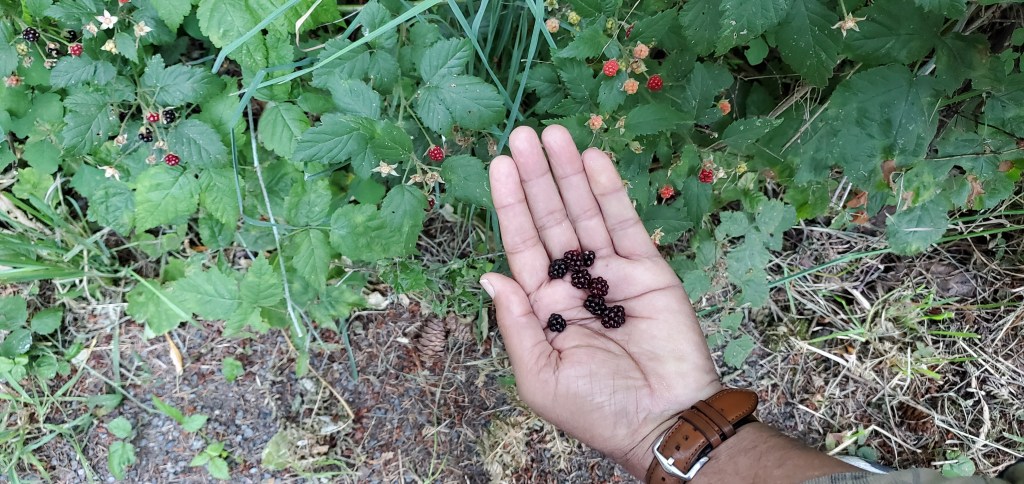
I am scared of walking down the same paths through the woods. Looking at the berries he loved to pluck out and eat. Every tree, every branch will forever ring with his absence. The last song he sang minutes before leaving us continues to echo in my ears.
I think of this world as a waiting room now. I can be called at any time. Anyone around me can be called. At any time. There truly is no guarantee. What will I spend my time doing till I am called? That is all there is now. There are so many lasts that have already happened. Many lasts are happening every day. A street I will never walk on again. Things I have looked at the last time without knowing. No one knows.
It is better not to know I guess.
When I miss him so much that I can’t breathe, there is a place in my mind I always try to go to. A beautiful moment stolen from a beautifully ordinary day. In the memory, I cannot see my dad. I cannot see anything. In fact, my eyes are closed, my head on the bench. I am taking an afternoon nap outdoors. I cannot see my dad but he is there, sitting by my side, sketching the scene in front of him. The undulating hill, the road below, and the beach segueing into the gleaming blue sea. I can hear the seagulls, excited voices, cars going by, and the sound of my father’s pencil softly grazing the paper. We do not say a word. But we both know we are together.
There is a highway bridge of my dreams. The light of the scene is blue. Two people stand there in the middle, staring at the dark waters. They stand with their backs to one another. The stream flows from one to the other. Though they cannot see one another at the moment, they have never been more aware that they are not alone.
Only now I am beginning to understand the things I wrote long back. How strange is that?
My mind is real. My memories more real than the present. I know I can will him into existence.
I don’t believe in god but I do believe in love.
I know I have my father’s hands and my father’s eyes. Sometimes when I am cleaning the car in the morning, sunlight glints through the branches of the mango tree, its leaves fluttering in the breeze. It always makes me pause and look up. The blossoms keep falling. The birds keep chirruping. I whisper under my breath—
Here is the world, dad. Here is life. Look.
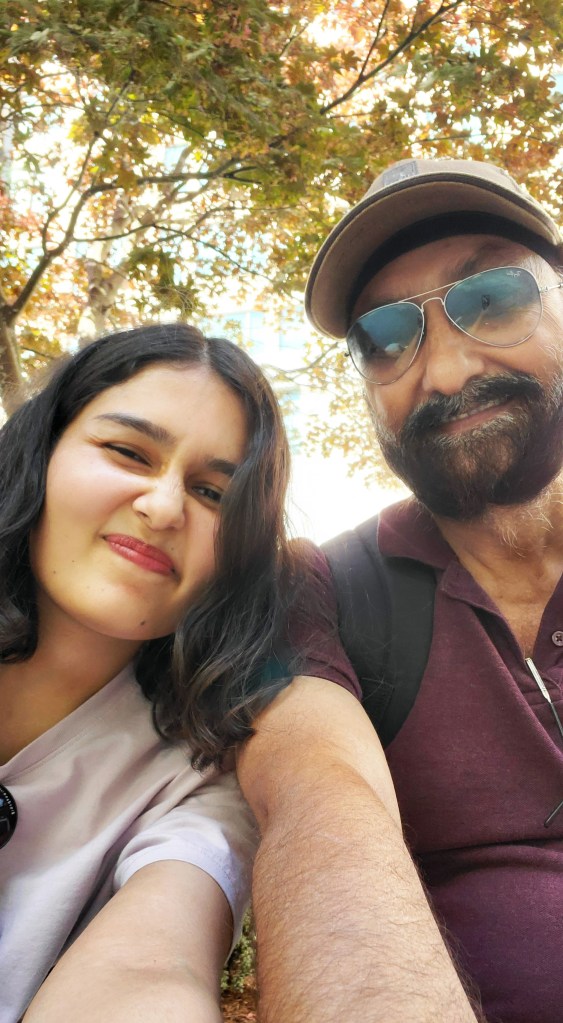
-
September 25, 2020“It’s stranger than every strangeness
And the dreams of all the poets
And the thoughts of all the philosophers,
That things are really what they seem to be
And there’s nothing to understand.”
Alberto Caeiro, The Keeper of SheepThough it is still September, the slight chill of October is already in the air. I can feel it early in the mornings and late in the evenings on the tips of my toes and fingers. Sometimes, some strange sights and sensations visit me, like fragments from another lifetime, pieces I have collected, first hand or not, of standing by rivers, dropping marigolds into them, the smell of incense, looking at temples lit with golden lights in the evening rain, staring at a strange path that went through the woods as I sat as a little girl in a white frock in front of my dad’s old scooter, laughing with a sister close to my age in a wooden house at a hilly place where it rained too often, as a man stepping outside my office onto a road covered in autumn leaves. I think of this vast field covered in reeds under a pale blue sky and two black horses waiting midst its windy sinews. They are my medium.
Loneliness accompanies these visions beautifully, without shattering the substance. But, in my room, loneliness floats around, sometimes like a dark shadow and at times, like the stillness of my heart, ready to listen. Anytime now. The orange light of the dying afternoon filters through a crack in the window and falls on the Kafka sketch on my wall. I believe one of these days he would speak. I stretch out my legs on the bed, trying to gather more sleep into my mind, to still it. But I am always thinking.
One of these nights, I will give myself up to the sky. I will say, this is me. This is what you get. Uncover me and see for yourself. I am surrendering. And the stars will zoom in around me and the clouds will wrap me up. I have nothing to carry that is my own and so I am in everything. Never have I felt so infinitesimal and so cosmic. Except that night on the roof.
In the darkest of nights, I have little to say. I leave myself to a prayer, if it could carry me all the way, if I am not heavy enough. I have caught myself in the mirror many times. When I see myself like that, I am touched and afraid. I would rather not.
I grow tired of the world. Words too at times. But only now, sitting at 12:25 AM, writing away, I can recall the beauty in everything. No. I have not forgotten strangeness and fear. I remember them. Like bones remember the flesh grimacing and sliding atop them. I know the potency of my mind. And I am afraid, I bow down. The mind. The neuroplastic monster. Madness. The psychedelic time machine. The dark sky, forever creating itself. Terror in a box. Tied fists. Blank.
-

Evenings are for the beach. I often take the driftwood for granted as I sit down. I am so busy looking at the sea. Though, as always, after a few minutes of vacantly looking at the waters, I am at loss. Am I supposed to be looking for something? I breathe easier here. Is that not enough? I feel guilty. What I am sitting on is a relic, a message, a layered poem beneath my ass. Yet I don’t really think about it. Only now, and even now, I am thinking about myself. When we say we can relate, is that a lack of imagination? I too am drifting, more or less, carrying some of the context on the way. When I listen, when I really listen, I think I can converse with all that will not speak. That chooses not to. And when I see, when I really see, I can see that the color of absence is much stronger than presence.
And so it is. When I try not to think of something, it is all I can think about.
This year I stayed away from all resolutions like a plague. I am so distrustful of it all. I feel like I need to experience time in my own way, build an extremely different relationship with it than what we have been taught since school days. I know now why I did not want to learn how to tell the time. I didn’t feel the need to. I want to see time falling all around me, malleable. I want it to expand and contract depending upon the orientation of my mind, or how rich my coffee tastes, how my feet feel as I sit in a café, my hand on my book, looking at people walking in the rain outside, re-living a random day of my childhood. I don’t need a stopwatch to examine my life, to count it, or expend it. I want my past, present and future at hand, ready.
In a way, getting older is an anachronistic acid trip. You can feel your past, present, future—all alive at once, underneath your skin.
That one summer afternoon, washing the dishes, I remembered my nani. I saw her as a girl, playing on the grass among the trees, running, happy. And I did not find it strange at all, even though I have never seen her as a little girl. But it made me think. Maybe time is not as linear as we want it to be/ thought it to be.
There is a highway bridge of my dreams. The light of the scene is blue. Two people stand there in the middle, staring at the dark waters. They stand with their backs to one another. The stream flows from one to the other. Though they cannot see one another at the moment, they have never been more aware that they are not alone.
This is a recurrent dream. The other is of two horses, one black and one white, standing among the reeds. Absence and presence.
I wish I could write a love letter—to all the erasures of the world, omissions of all kinds, absences.
As you read this, countless erasers, backspace keys, delete buttons, and forgetfulness are busy expurgating space. Things get lost. Misplaced.
This morning, I could not find any scissors around the house. No matter where I looked, I could not find them anywhere. I realized that I do not pay much attention to scissors when I use them. I find them, as a matter of fact, and use them as modes of convenience. But today, I kept finding out how much I needed such a simple thing in my life. I could not open the coffee bag without it. I used a knife instead and ended up getting a cut. I wanted to cut off a stray thread out of my sweater and tried to use the nail cutter as a replacement but it was too small. I spent the entire day looking for replacements for carrying out simplest of tasks. And when I finally found it, I had a new sense of admiration for it. The same thing happened when I could not find my earphones before going for my walk and realized that sound added an invisible layer to my walks, without which I felt too exposed when I stepped outside. Though it also allowed for the bird songs to bless my ears and I was grateful for that.
But what struck me the most about the absence of things is how it makes their presence so lucid. In their absence, their very essence stands out in relief. It is almost as if when all the blocks associated with that one thing in our day-to-day life get taken out, it ignites a series of fissures, gaps that disrupt an overall flow of our day and that is when we notice the burden that that one thing carried, the space that one thing occupied, good or bad.
Absence can do that. What presence often cannot.
The whole narrative about learning the value of something that you no longer have—there is no escaping that. And how often we color that absence within our imagination. The mind comes across absence and feels the need to create a presence out of it and inevitably ends up making it rosier or more terrible than it was.
How vivid absence often is for that very reason.
How blind we are to what is around us at the moment.
There might be a lesson here but I am in no mood to talk about lessons. For all our knowledge and understanding we are like raccoons, watching our cotton candies dissolving in the water, bamboozled by it all. (I am sure you have seen that video).
And I don’t wish anything different. Some confusions are mercies in a way.
And what about omissions? Can there be anything more present than that? What we keep to ourselves, what we do not talk aloud about, what we type and erase, what we hide—tell me but don’t we come closest to truth in those moments? The other day I ended up sending a cat video link to my father instead of the link to a government website. So of course, I deleted it to avoid confusion and sent the correct link. And as you can expect, my father was so keen to know what I had just deleted. To know what his daughter could possibly have to hide. As if that could define our relation. The same thing has happened to me a thousand times. People feel they are on the verge of finally knowing you if they catch a whiff of what you keep in the dark.
And they are not wrong.
As Fitzgerald wrote, “What people are ashamed of usually makes a good story.”
For all our communication, we have not learnt to truly unlock our seclusion. The heart of our darkness.
What you choose to omit, the words you do not write down, are the ones that are most burning.
And I wonder—
Is forgetfulness absence? Or is remembering the first condition of recognizing an absence?
And we are forgetful. I guess it depends on how this works. Can we choose to forget? For often there is so much that we want to forget and cannot. And yet we are constantly forgetting so much. Erasure evades the fringes of our memories at all times. Or maybe all those memories are not lost, simply packed away, archived for now till something triggers their revival. (People dying often get flashbacks of memories they never thought they would remember again or had even registered).
All my life I have always believed that I would magically become the woman I have dreamt of becoming one day. But not all accretion is of the nature we want it to be. And that is okay. I am gaining branches but my essence doesn’t shine any brighter. My spirit hasn’t changed. It’s like my gravity is pulling together all the grit and debris of the universe. I am turning into a big ball of ego and yet it isn’t enough. For the moment, I am drifting. Gathering layers. I have stories to tell myself on the way. Push and pull. I will play along.
After all, I am in no hurry to reach the shore.
Are you?
-
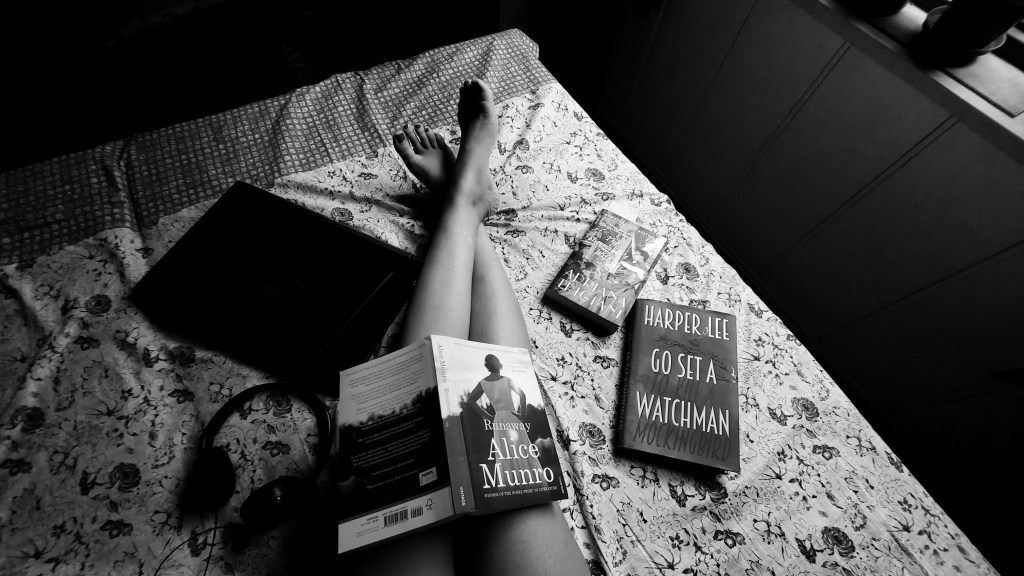
13/4/2020
Last night as I was reading Runaway by Munro, I happened to eavesdrop on one of the characters. She, in turn, had been reading about kings and queens who were turned into constellations for being too arrogant or beautiful. Together we thought of the gods getting jealous of those that shone with a fire too bright for this world, turning them into examples, into distant objects of our admiration, hanging them onto the skies above our heads.
These days in the evening we go to the roof of our house for our evening walk, since it is not really safe to go outside anymore. As you already know, outside is where an invisible apocalyptic reality awaits. My mother is usually on her phone. She attends her work related calls there. When she’s not doing that, she jumps like a cat over to the roof of a neighboring shop to look at the people passing by on the road. I tell on her to dad and he just smiles and lets her be. Dad usually brings his wireless radio upstairs with him. Sometimes it’s not charged and a woman’s automated voice starts interrupting the songs. And I have absolutely no idea whatsoever as to what she is saying, or the language in which she says it. It’s a daily ritual. I usually carry a Munro book along, to read. I walk and read. I find it really stimulating. And I like the evening light falling on the pages of my books. It’s not the stark sunlight of the afternoons, but softer, more gently luminescent. Everything that I read appears so much more profound in that light. I go around in circles by the mango tree that has grown tall enough to reach our roof. Often, I pause to take countless futile pictures of the sky and the growing mangoes that I fill mum’s phone with. Nothing gets captured the way I want it. Then as the sky turns blue and it gets darker, I place the bookmark where I left off and close my book. It is around seven in the evening these days when the twilight spreads across the sky and it is time for the evening news on the radio which is usually about the virus. Sometimes I listen, sometimes I don’t. The evening star appears and another ritual is performed. I have no idea how it started. I think it was my mum’s idea. Every day she asks us all to say a little prayer of gratefulness to this constant star, thanking it for another day spent safely. And we all do. Somehow when I see it, I cannot see it. When I don’t see it, I can feel it more. So I look back at it, startled for not having paid enough heed to it and it is right there, a little speck of light. I feel slightly disappointed with things I can see. I take them for granted I guess.
In any case, Venus is known to absorb the ill tempers of the more mercurial forces in the universe. Being benign, I wonder how she looks upon us. Probably, she is already sick of Mars throwing his tantrums all over space. How long before Venus has had enough? Or is her capacity to absorb the heated violence around her infinite?
There is this story of the eagle I keep asking my dad to narrate over and over again, simply because he hates to. During the lockdown, since he could not escape me, I must have asked him to tell this story a hundred times by now.
Once upon a time, an eagle flew into my dad’s house. I don’t understand exactly where it landed or how. Even though I heard this story so many times, I am still pretty confused. He calls the exact place the ‘padchatti‘. It sounds like something I have a vague understanding of but don’t understand well enough to define it for you. Anyways, this was from before he had married mum, or we would know who would have to take care of it right away. Every time a wild creature is found in our house (for us, a wild creature would mean a rat, a mouse or a wasp), I am the first one to jump onto a chair or a bed or hide behind the curtains and dad is the first one to demand the creature’s swift banishment from our kingdom while slowly sneaking away from it. There is only one warrior who can fight these stranger beings. And that is my mother. And she comes with a broom or in case of wasps, covers herself from head to foot, marching like a fighter straight out of Star Wars with her helmet and gloves. But in any case, when the eagle got stuck at ‘that place I do not know of’ and would not leave, dad was still a bachelor and mom, who had not yet met him, could not come to the rescue in her avatar. So, he had on his hands an eagle that had somehow got trapped indoors. And on top of that, it was sick and retching. This probably had to do with the fact that somehow, it could not find its way out. Anyways, it smelt really horrible in there. That is what my dad recalls when he thinks about it. In the end, it was my grandmother who came in with a ‘dang’ (a wooden stick) and urged the eagle to fly away from the window. Somehow, I am unable to imagine a grand creature like an eagle being indoors in a congested space built by humans. It was made to roam the high skies. It fascinated me to think of such a big bird and its wonderful expanse. I was glad and relieved when every time during yet another narration, it found its way out and flew away. And I was curious about something else. I wanted to know what it felt like, looking at it in the eye? When I asked dad to describe it to me, he said it was ‘big’. That was it. He wouldn’t tell me how big or what its eyes looked like either. I guess he was too overcome by the smell. In any case, he said, if I had been there, I would not exactly be ‘fascinated’.
15/4/2020
Every time I read Munro, I am wonderfully disturbed. I asked my mum once, what do you do when you read something that you resist but know to be true? She said I never thought about it much. And I wondered how blissful that must be, to be so preoccupied with the act of love, work, life, happiness, to not have such thoughts. But reading Munro- well- it is like, every time her heroine is on the verge of taking any step, I hold my breath and pray for her to not do it, to stay the way she is, to be safe, discontent but safe, to avoid a disaster. But she ventures forth anyway and I know she would still be discontent. And I wonder, did I? Did I venture forth? Why am I so afraid? Did something go wrong? No. That is not the question. What bothers me is, did I venture forth, if at all? And if so, when?
There is this particular part of the terrace at my house from where, if you look down, you can see the street through a frame of the mango trees, the loquat tree and the crisscrossing street wires. But the banisters are really shallow and so it is kind of a risky business. This was the very reason because of which my brother wasn’t allowed to fly kites on the terrace, though he badly wanted to. This is the spot where my mother, sometimes my dad, and sometimes I, go to peek and strangely every time one of us does so, the others pull him/her back by the arm or at least there is a verbal warning shouted from behind. It’s out of love and fear. And it made me think, how for safety and security, a family becomes that force that won’t let you venture out into those terrains, or even into a dangerous adventure of any sort. This used to happen every time I was near water. I badly wanted to go closer, an almost primitive need. I wanted to walk down the fairie roads of Scotland which were supposed to be haunted, but my mother would not allow it. Be safe and safe. Be safe. Have regrets, of not knowing, but be safe. A strange fury would take hold of my mother as she would pull me back, going as far as lashing out personal comments on how I couldn’t stay put, with everyone else and always had to venture forth on my own. Why was there this need of being isolated and hence being somewhat ‘special’ stuck in my head? Could I not enjoy with my family, like everyone else? Strangely, this need to venture out was in her too. I seemed to have bequeathed it. But years later I found myself saying the same things to those I loved. Be safe, come back.
But what happens if you are on your own? Is that preferable? Not at all. Read this excerpt from Munro’s Open Secrets (and I’ll be quoting a bit of it today). It is about this Canadian woman who is exasperated with her traveling companions who are all middle aged and easily alarmed:
After dinner they walked on the terrace but Mrs. Cozzens was afraid of the chill, so they went indoors and played cards. There was rain in the night. She woke up and listened to the rain and was full of disappointment, which gave rise to a loathing for these middle-aged people… These people ate too much and then they had to take pills. And they worried about being in strange places- what had they come for? In the morning she would have to get back on the boat with them or they would make a fuss. She would never take the road over the mountains to Cetinge, Montenegro’s capital city- they had been told that it was not wise. She would never see the bell tower where the heads of Turks used to hang, or the plane tree under which the Poet Prince held audience with the people.
Alice MunroThe next excerpt is from when her guide gets attacked by the tribe of a kula and she is herself taken in by them as she is injured and she thinks about how her absence would not be even registered:
No doubt there was some sort of search for her, after the guide’s body was found. The authorities must have been notified- whoever the authorities were. The boat must have sailed on time, her friends must have gone with it. The hotel has not taken their passports. Nobody back in Canada would think of investigating. She was not writing regularly to anyone, she had had a falling-out with her brother, her parents were dead.
Alice MunroI read these lines and I can sense the panic rising in me for the character. No one calling you, worrying about you anymore. Even the thought of it is scary. Its natural isn’t it? We want someone to worry about us too. In Munro’s other book (Runaway), I was reading about how Juliet’s daughter Penelope goes to a retreat one day and the wait of a few days turns into weeks, weeks into months and then to years till Juliet feels like the Penelope she knew does not exist. She gets to know about her daughter indirectly from her daughter’s friend who unleashes information about her daughter on her nonchalantly, because she doesn’t know the rift between the two. And Juliet finds out that her daughter already has three kids and she was seen in a mall, unrecognizable, to get uniforms stitched for her children. I was horrified to read this. My mind cannot, by the biggest leaps of imagination, imagine such a situation. What was that big blunder that Juliet had committed for Penelope to be so unforgiving? Maybe it was some buried grief. Dysfunctional relationships. I don’t know. My Indian mind cannot comprehend. And yeah, it was at that moment when I realized how being born in a certain place can change you completely and leave its imprints. Indian families do tend to stick together, sometimes beautifully, sometimes in toxic ways. But they do. And in times of crisis, they stick together even more. I think of this as we sit together, eating mangoes. Outside, the skies continue to darken as the world inevitably ventures forth for a tryst with the morbid unknown.
-
I am writing this blog when humanity is sleepwalking through a pandemic. Historians are urging people to document their lives. And we are doing just that- in our own myriad ways. But there is another side to this pandemic that makes me wonder, if it is as my mum said, “nature’s way of restoring balance”. If so, nature observes us very intelligently, sentiently. This is by no means a direct cataclysmic phenomenon like the melting of the icecaps caused by climate change. This seems to be very psychological, very much politically assertive. It has changed or at least brought to a relative hold the maddening capitalistic race. And though I am feeling an enormous sense of absence, and empathy for those who have to risk their lives every single day to save others and those who grieve, I am awestruck by this force that is bigger than us. It is quite humbling really.
One morning, I had been dreaming about the aesthetics of light and shadow and I dreamt that my parents wanted the entire house to be rearranged with respect to the classical aesthetic rules. Like the crevices and the protrusions had to be alternative, everywhere. I thought of the senseless impossibility of it all, the practical impossibility. But deep inside I was amused. Maybe it’s just that. What artists do at the end of the day. They try to keep the world amused as it goes through catastrophes, together at times, at times alone in their lone rooms.
But there is more. And it is one of the reasons why I am writing today.
I think a part of me wants to resist self-reflection or a more reflexive monitoring of my own thought processes. In a way, I want to be unaware and observe other lives, so I can come to understand mine, slantingly. Maybe that’s why I like looking at the world through the window of a book. I don’t want to face the world head on. I want to learn from life without paying its heavy prices.
What triggered this? Maybe reading Alice Munro? I was reading the introduction to Alice Munro’s Runaway. It said, “What Makes You So Sure You’re Not the Evil One Yourself?” Now you see, I have always felt that I was the evil one, but for different reasons. Let’s take morality, for instance. I cannot take a morally high ground because of my past thoughts, if not actions. I have no right to judge anyone else. But that’s not the evil I have in mind, the one that dwells within. It is the very fact that I can think of judging at all, irrespective of my thoughts/actions. Rather my thoughts that fell outside the realm of a morally high ground, where I admitted to being the evil one, made me human and humble. The upholding of a higher ground left me stone cold. But I don’t really know about that. For instance, I do not really know at what point our understanding gives way to conditioning. Our insecurities. The part played by a cruel economic reality. Our upbringing, education, differences, patriarchy. All I do know is that even though I understand these things and comprehend their import, but what is already inside me, has been inside me for years, how do I uproot it after decoding it? How do you stop feeling a certain way? I am talking not of being politically correct, but of our most private thoughts and feelings whose continual presence we may never admit to. How do feelings change? How do you start feeling differently about something? The mind itself is a maze. What is it that can profess to reaching its core, its depths and creating a seismic ripple? I firmly believe that this is where a reading book comes in.
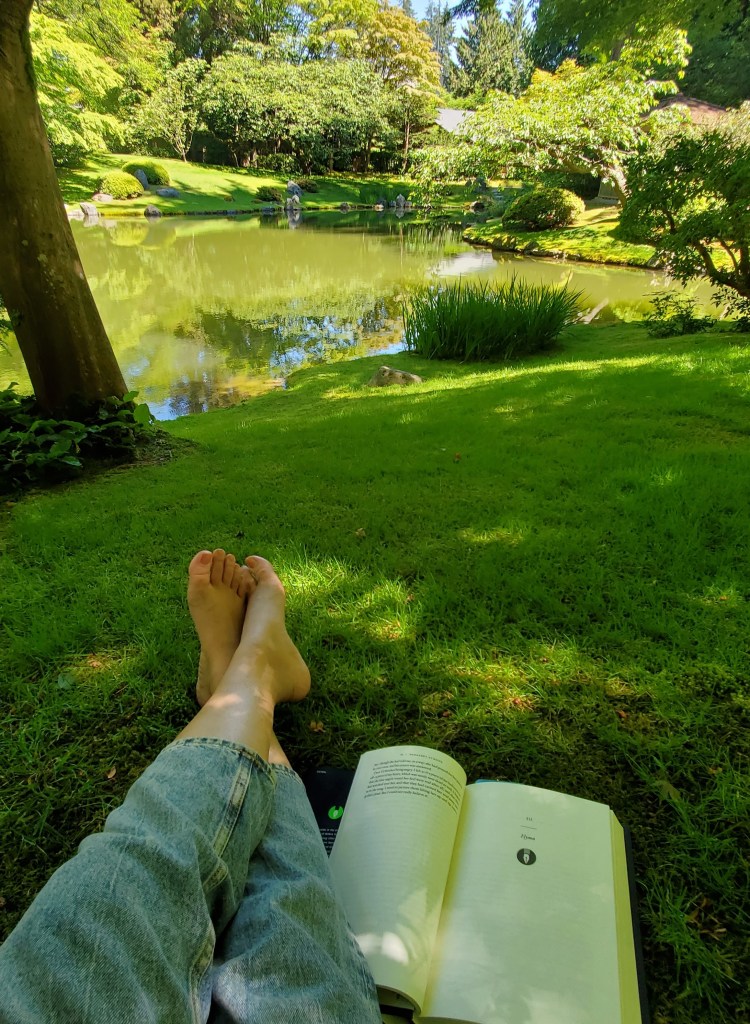
It is beautiful how you begin to trust an author’s world. I trust fiction with my life. I can allow a book to look into me and slowly make me see things that I do not otherwise wish to see. And when I read the story “Dolly” in Dear Life, I just knew it, I lived that story, every word of it. And I thanked Munro with all my heart for having written it so stunningly truthfully, so stark, so honest, so cruel and yet so healing. It was what I needed. Not a reductive sympathizing of a half distracted and equally confused friend. I needed Munro’s insight. I need intelligence which does not stop being human, does not stop being cruel, does not fall short on truth to sound sweet, does not turn into a godly dictum, does not try to lift me up but sits with me in the ditch and lets me see what is happening in an entire universe inside me. And every sore that Munro masterfully touches, begins to heal in the delicate light of comprehension.
And so today, I extend my thanks to the authors. I owe it to them for having written across time and space, for reaching out without fail to those that needed to hear their guiding voice, and for creating these insightful portals to life. Now I am truly beginning to understand why it is so important to make art. Not only for what is happening inside of you but how by being true to yourself, you can make other people’s journeys less lonesome. It doesn’t matter how many people read it, see it, reward it. Even if one person does, it matters to the universal balance of things. Butterfly effect.
I think I am going to come back to this quote all my life. It is from one of Munro’s interviews:
Because there is this kind of exhaustion and bewilderment when you look at your work… All you really have left is the thing you’re working on now. And so you’re much more thinly clothed. You’re like somebody out in a little shirt or something, which is just the work you’re doing now and the strange identification with everything you’ve done before. And this probably is why I don’t take any public role as a writer. Because I can’t see myself doing that except as a gigantic fraud.
Alice MunroThis does two things distinctly for me, out of many. One, that the feeling of revulsion and distaste I get when I look at my past work, is normal. I never have to look at it. I have to look at what is happening right now. What I am making right now. What I am doing right now. That is all that is me. And that gives me immense relief. And secondly, it’s okay not to be the accumulation of all you have done. We are all moments. To say otherwise is to be fraudulent. A very dangerous territory.
And so we must, thinly clad as we are, continue to read, write and create art, while the storm rages outside. May we enjoy the tranquility offered by this shelter of words. May the catastrophe outside reveal newer undulations of the future on the horizon, forever holding its breath, waiting, yet to be explored. And yet, very often, the best of adventures happen indoors, deep within yourself. Down the rabbit hole, and into the recesses of the mind!
 Uhi K;