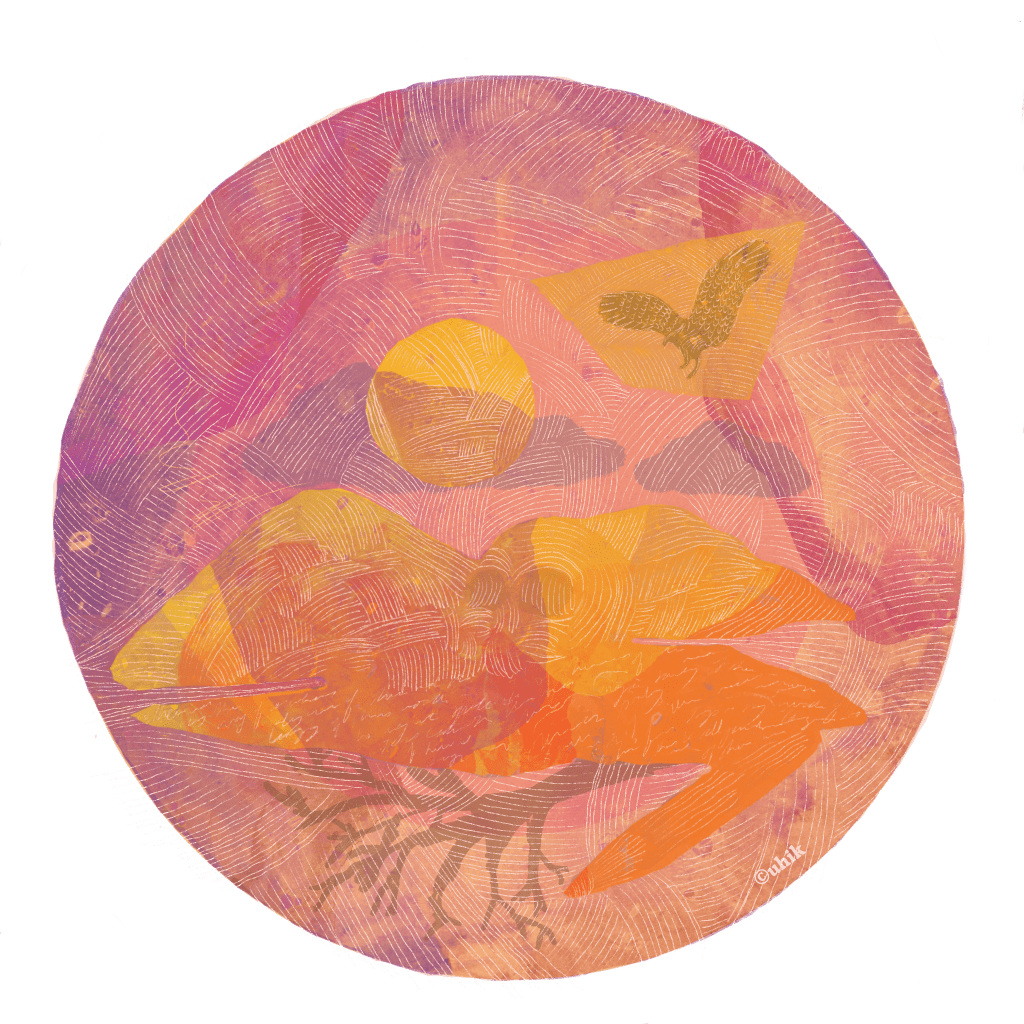
The time traveler, it seemed, had been left behind by time. And as is the nature of things, time took away everything else. The traveler who could not catch up, was left floating in an alien space where all that could perish had disappeared.
Here she was, in a cosmic corner where she was made privy to states of being that had a presence beyond time. She wondered if she too, now, was to be one of them. Was she now at the periphery of knowledge that was no longer immediate?
But what did it mean to be left behind by time? Would she not age? But what about her constant state of being that had continued to drift? Did that not mean that time had continued to flow? If not, then was eternity the absence of time? Was time like the grim reaper, eating away at lifelines, probing everything to shift ever so slowly towards maturity and dissolution, only to reap it all back again, scattering it all, like seeds into a flux? So, did nothing really change?
Or was being left behind by time as good as being immune to its effects, like being a god—an unchangeable witness to a constant conglomeration of beings, whose legs, wings, tails, and stalks continued to grow or disintegrate into newer faces, blossoms, and sounds?
She too pondered over this, of being thrown outside time. And she wondered that if she had been spared, what bit of the universe had replaced her? If something had escaped the time bubble, something must have entered it. As she continued to drift around, a new fear took hold of her. If time had left her, was it the same as saying that time had stopped for her and her alone? If so, would she disintegrate, cease to exist? Could space exist without time? Could anything exist without time? Could she imagine an uncontained state of void? If so, that was all that could exist—but wait. Could even void exist without time? She could not imagine it. As she could not imagine ‘not existing.’ But something had to change. Her form had to change. Form itself had to change into something else—a sound, maybe? Or simply ‘being’ had to change. And what if change did not exist outside time? Maybe nothing existed. Not even nothing. What was this state?
What was this state? Not even nothing. Maybe nothing existed. And what if change did not exist outside time? Or simply ‘being’ had to change. Form itself had to change into something else—a sound, maybe? Her form had to change. As she could not imagine ‘not existing.’ She could not imagine it. Could even void exist without time? If so, that is all that could exist—but wait. Could she imagine an uncontained state of void? Could anything exist without time? Could space exist without time? If so, would she disintegrate, cease to exist? If time had left her, was it the same as saying that time had stopped for her and her alone? As she continued to drift around, a new fear took hold of her. If something had escaped the time bubble, something must have entered it. And she wondered that if she had been spared, what bit of the universe had replaced her? She too pondered over this, of being thrown outside time.
Or was being left behind by time as good as being immune to its effects, like being a god—an unchangeable witness to a constant conglomeration of beings, whose legs, wings, tails and stalks continued to grow or disintegrate into newer faces, blossoms, and sounds?
So, did nothing really change? Was time like the grim reaper, eating away at lifelines, probing everything to shift slowly towards maturity and dissolution, only to reap it all back again, scattering it all, like seeds into a flux? Did that not mean that time had continued to flow? If not, then was eternity the absence of time? But what about her constant state of being that continued to drift? Would she not age? But what did it mean to be left behind by time?
Was she now at the periphery of knowledge that was no longer immediate? She wondered if she too, now, was to be one of them. Here she was, in a cosmic corner where she was made privy to states of being that had a presence beyond time.
The traveler who could not catch up, found herself in an alien space, where all that could perish had disappeared. And as is the nature of things, time took away everything else. The time traveler, it seemed, had been left behind by time.
When I think of the time traveler who was left behind by time, I think of being trapped inside the mind in a constant state of glitch where one moved back and forth and hence, not at all, for if this motion went unrecorded, then the state of being, as perceived by us, was left almost unchanged. The time traveler has no idea of this glitch. She thinks her thoughts are progressing linearly, when in truth, they are caught in a constant loop. But within that loop, time too is trapped, unable to flow linearly, from the past to the future—constantly gaining in mass.
Or maybe, what is trapped is our mindset that refuses to imagine time otherwise. What if the past and the future are in a constant state of co-existence that our minds cannot grasp? What if all that which we thought lay before us, is already here? Let us move further, not backwards, for our language continues to be linear, bearing down upon the toing and froing flux of our minds.
Now the question we must ask ourselves, dear reader, is this: How can we possibly imagine the utter absence of space and time?
Our understandable inability to answer as such questions makes me think of robots short-circuiting as they, in turn, think about this evasive sense of being that they cannot pinpoint, but which we, as their creators, would know to be dreams and emotions. What is this absence which they feel, even without having ever known it? There are things that are not there in our programming, it seems.
The absence of time, space, and matter, can be written about, but how do you visualize it? Maybe it cannot be seen. After all, sight as a sense may be overrated in the scheme of the universe. What do we know? Sight could be blinding us in this context. I apologize for this roundabout way of saying things that cannot be avoided and must inevitably be used as a crutch, for we are too deeply engulfed in the automatic associations certain words and senses bring to our human minds.
Let us, for a moment, imagine a world where sight is a hindrance. We cannot. Something about the way we were made among other beings on this planet, asserts the assumption that sight serves an important purpose in our day to day lives and so we resist countering this ‘fact.’
We are made of time, space, mind, and matter. To imagine otherwise, is to cease to exist. And though it may be something you can think of, how do you imagine it? How do you imagine presence or absence? Presence, you might say, can be imagined and even empirically verified. But how do you imagine absence? Is it simply the absence of a presence that once was? What of that which never was? How easily we relegate all that we cannot see, hear, touch, feel, think, remember, or imagine, to a place that, for us then, simply does not exist.
And yet, how is it that slowly we are probing into those spaces? It is amazing that humans can record and remember. After all, our short lifespans on a geological scale would otherwise inhibit our development. So, humanity as a collective being, must record and leave something behind in time, like notes for an amnesiac who cannot remember after every few hours, all that she knew before. It seems, slowly and slowly, before venturing forth, you need to learn all that was left before you came into being.
For as the darkness continues to descend and meanwhile, you do not want to walk around doing the chores you already finished doing in a state of forgetfulness, which too, continues to play like a loop.
Maybe somewhere in the deepest recesses of our minds, doing laundry or dusting the shelves reminds us of our Sisyphean existence, and a part of us that dreams of the universe beyond the laundry basket, wishing to venture forth into the unknown.
I sometimes think of it so: it is the philosophers who are left with this wondering, as all others continue the slow yet essential drudgery of keeping the debilitating forces at bay. A philosopher’s task is to continue to throw darts into the unknown, not knowing if and where they will land, or worse, be prepared to be fired back at. Their only tool is the mind and a constant battle to transcend the limits of their bodily senses that pin them down to the human programming. It really fascinates me when I think of philosophers assuming they are gods, of scientists suddenly turning spiritual at the threshold of a discovery, or poets actually becoming cult members.
And why not? When you are faced with those mysterious states of being that have a presence beyond anything that you have known all your life, the experience does suddenly turn spiritual and paranormal. For admitting that there is something beyond what we know collectively—not as a regurgitation of its components, but as something entirely new, another dimension altogether—is to take a leap towards the super-human, is to step outside our programming. It is not to travel anywhere but to suddenly wake up one day and see the world with new eyes.
And yet, it is not the same world, surely, as Heraclitus would have us believe. So, in a way, we are traveling. And the philosophers are the sailors, navigating us through terrains that go beyond the known and the unknown, slowly charting bits of it in moments that erupt in our world as nothing short of revolutions. And that, in itself, is not an easy task.
Yet, often, even in those moments, as the world rejoices and looks on in awe, the thinker continues to have a nagging thought: What if this color that appears as an emotion and spreads across the mathematical network of the electronic chip like a slowly blooming flower, is at its best a programmed miracle?
I know what you are thinking. There are no answers here. Only loops. That is exactly my point. But I will leave it at that.
 Uhi K;
Leave a comment